Project Monarch Programming: Where the Official Record Stops
What can the surviving record still certify about MK-ULTRA, and what can it no longer certify about Project Monarch methods?
This case starts with a mismatch between a popular label and the small set of documents that can be cited without drift.
- CIA FOIA Reading Room entry anchors MK-ULTRA naming
- CIA PDF: more than 130 research programs
- SSCI hearing record exists as an oversight artifact
- Rockefeller Commission created Jan 4, 1975 with a United States remit
- Clinical literature: dissociation is trauma-related, not validation of Monarch programming
These points mark the stable edge of certification in this source batch, and nothing outside them is stabilized here.
CIA FOIA Reading Room entry 06760269 as an evidence gate for what MK-ULTRA can be called
A reader arrives at a CIA FOIA Reading Room page displaying a single document number: 06760269. The page functions more like a catalog entry than a narrative.
The administrative act is the public posting of a description under that identifier. The visible text is treated as the CIA’s own framing for this item.
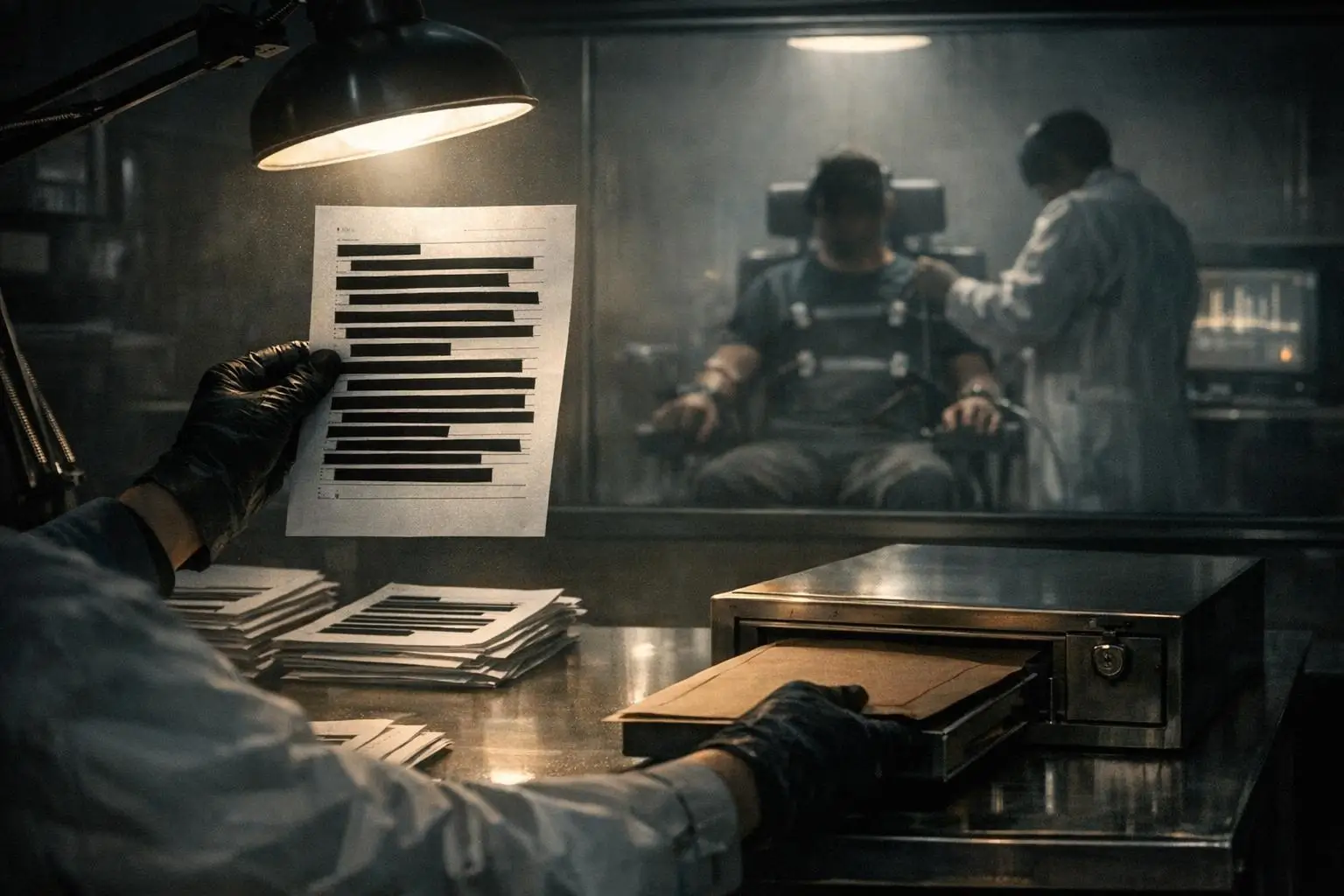
Within that entry, the preserved line reads: ‘Project MK-ULTRA, MK-ULTRA, or MKULTRA, was the code name for a covert CIA mind-control and chemical interrogation research program…’
The word ‘covert’ appears inside that same preserved wording. The description also locks the phrase ‘mind-control and chemical interrogation research program’ to this FOIA context.
No parallel label such as ‘Project Monarch’ appears on this page. The entry does not present a technical protocol for trauma, triggers, or dissociation.
The artifact therefore certifies a naming boundary and a short institutional description, while leaving operational detail outside the frame of this entry.[1]
This entry can certify the official label and the exact descriptive sentence, but it does not certify any trauma-based programming methodology. That pushes the next question toward scope language elsewhere.
CIA-RDP88-01070R000301530003-5 and the one quantified scope phrase that can be repeated
A separate CIA-released PDF preserves a single quantifier often repeated without its document boundary. In that PDF, the wording is: ‘MK-ULTRA consisted of more than 130 research programs…’
In this batch, that phrase can be treated as a certified scope statement only as it appears in that specific PDF. The material provided here does not stabilize a complete enumeration of the programs behind that number.
The unresolved step is not to enlarge the number, but to locate primary subproject or contract records that would show what any one program did in documentary terms.[2]
SSCI hearing record PDF as an oversight artifact with limits inside this batch
The provided sources include an SSCI hearing record PDF titled ‘Project MKULTRA, the CIA’s Program of Research in Behavioral Modification.’ That title establishes an oversight setting, separate from CIA FOIA catalog language.
This batch does not preserve specific quoted passages from the hearing record beyond what is named in the brief. The hearing can be cited as an existing documentary object here, but not as a container for additional claims not extracted into the brief.
The next unresolved task is retrieval-focused: if the hearing record contains statements about record availability or program structure, those statements must be lifted precisely before they can support any mechanism claim.[3]

Rockefeller Commission final report as an executive-branch marker with a defined remit
The Rockefeller Commission final report provides a dated oversight marker in the executive branch record. The preserved wording in the brief is: ‘President Gerald R. Ford created the Commission on CIA Activities within the United States on January 4, 1975.’
The same excerpt frames the mandate as ‘CIA activities within the United States,’ and it continues: ‘He directed the Commission to determine …’ The ellipsis matters because the brief does not preserve the full directive language.
This report can therefore anchor that an inquiry structure existed with a stated domestic remit. It cannot be used here to certify conclusions about specific alleged techniques not preserved in the provided excerpt.[4]
Clinical dissociation literature as a separate domain, not an operational proof
Peer-reviewed clinical literature in this batch treats dissociation and dissociative disorders as clinical phenomena related to trauma. The brief also states that this literature does not validate the construct of ‘Monarch programming’ as a formal diagnosis or established technique.
A PubMed-indexed study record supplies one measured association that can be repeated without converting it into design language. The preserved finding is: ‘The results revealed higher dissociation in victims of childhood abuse and neglect compared with non-abused or neglected subsamples…’
What this clinical layer does not do, in the materials provided here, is connect those clinical constructs to MK-ULTRA documentation as an explicit designed CIA methodology. The unresolved step is archival, not interpretive: locate primary MK-ULTRA subproject or contract records before claiming any trauma-to-dissociation mechanism as an official technique.[5]
Where the provided archive goes silent on Project Monarch, butterfly programming, trigger words, and systematic abuse as official methodology
The central contradiction in this case is simple in documentary terms. Validated Tier 1 records in this batch support MK-ULTRA generally, while the provided results do not substantiate ‘Project Monarch’ as an official program name.
The same limit applies to technical claims. No primary documentation in the provided results links MK-ULTRA records to Dissociative Identity Disorder mechanisms or to ‘systematic abuse’ protocols as a designed CIA technique.
One permitted routing tool in this batch is a National Security Archive briefing page that points toward collections, without serving as standalone proof. Used carefully, it only identifies where primary materials may reside. It cannot replace primary language for claims about terms like ‘MONARCH’ or ‘butterfly.’[6]
Closure: what the record can certify, and exactly where it stops
The opening question asks for a technical methodology of trauma-based control under the label Project Monarch. The record provided here does not stabilize that label as an official program name.
What can be certified is narrower. A CIA FOIA Reading Room entry preserves the wording that MK-ULTRA was the code name for a covert CIA mind-control and chemical interrogation research program, and a CIA PDF preserves the phrase that MK-ULTRA consisted of more than 130 research programs.
Certification stops at two concrete breaks in this batch. No Tier 1 document here uses ‘Project Monarch’ or describes butterfly programming or trigger words as an official CIA methodology. No primary document here links MK-ULTRA documentation to Dissociative Identity Disorder mechanisms or systematic abuse protocols as a designed technique.
The next step is therefore archival and term-bound, not narrative: retrieve primary subproject or contract records, and only then test whether any document language connects these domains.[1]
FAQs (Decoded)
Is Project Monarch confirmed as an official CIA program in these sources?
No. The brief states that no Tier 1 document in the provided results explicitly uses the name ‘Project Monarch.’ Source: CIA, FOIA Reading Room entry for Document 06760269.
What exact wording can be used for MK-ULTRA without drifting beyond the record?
The CIA FOIA excerpt preserved in the brief states that MK-ULTRA was the code name for a covert CIA mind-control and chemical interrogation research program. Source: CIA, FOIA Reading Room entry for Document 06760269.
What does the provided batch certify about MK-ULTRA scale?
Only the specific quantified phrase preserved from the CIA-released PDF can be repeated here: MK-ULTRA consisted of more than 130 research programs. Source: CIA, CIA-RDP88-01070R000301530003-5 PDF.
Do these documents link MK-ULTRA to Dissociative Identity Disorder as an explicit designed technique?
No. The brief states that no primary documentation in the provided results links MK-ULTRA documentation to Dissociative Identity Disorder mechanisms or protocols as a designed technique. Source: Senate Select Committee on Intelligence, hearing record PDF.
Do the clinical dissociation sources validate Monarch programming as a clinical construct?
No. The brief states that clinical literature treats dissociation as trauma-related and does not validate ‘Monarch programming’ as an established diagnosis or technique. Source: PubMed Central, Trauma-Related Dissociation and the Dissociative Disorders review article.
What is the Rockefeller Commission document used for in this piece?
It is used as a dated oversight marker with a defined remit focused on CIA activities within the United States, as preserved in the brief excerpt. Source: Ford Library, Rockefeller Commission Report Final.
For additional documentation in this domain, consult the real conspiracies archive or the behavioral research files. Related case records include the mkultra program files and project artichoke records.
Sources Consulted
- CIA, FOIA Reading Room entry for Document 06760269. cia.gov, accessed 2025-02-17
- CIA, CIA-RDP88-01070R000301530003-5 PDF. cia.gov, accessed 2025-02-10
- Senate Select Committee on Intelligence, hearing record PDF. intelligence.senate.gov, accessed 2025-02-03
- Ford Library, Rockefeller Commission Report Final PDF. fordlibrarymuseum.gov, accessed 2025-01-27
- PubMed Central, clinical review article page. pmc.ncbi.nlm.nih.gov, accessed 2025-01-20
- National Security Archive, briefing page on CIA behavior control experiments. nsarchive.gwu.edu, accessed 2025-01-13

A Living Archive
This project is never complete. History is a fluid signal, often distorted by those who record it. We are constantly updating these files as new information is declassified or discovered.