MKUltra CIA: Between Documented Programs and Destroyed Files
What can CIA files still certify about MKULTRA in 1953–early 1960s, and what did the 1973 destruction make unreachable?
Project MKULTRA survives in public view through a thin set of declassified papers and later oversight records, not through a complete operational archive.
- Covert CIA research program: behavioral modification and chemical interrogation
- Formal approval in 1953, main discontinuation in the early 1960s
- More than 130 research programs across universities, prisons, hospitals, other settings
- LSD and other psychoactive drugs, including covert dosing of unwitting subjects
- 1973 destruction of many operational files, leaving mainly financial and administrative traces
These points mark the stable edge of what the surviving record can certify, without extending past what the archive preserves.
The MKULTRA Subproject 68 FOIA file as a surviving administrative object
A declassified Subproject 68 file sits in the CIA Reading Room as a unit of paperwork rather than a narrative of what happened in a room.
It preserves a project framing and related funding material. It treats the work as a discrete subproject that could be approved and supported through documents.
The administrative act visible here is authorization through recorded support, not a description of procedures on subjects. The file format makes the program legible as managed research rather than a single experiment.
What remains in view is the logic of organization: a subproject number, a defined research scope, and documentation linking the work to MKULTRA. What is not stabilized is the full operational detail that would sit behind the paperwork.
Some passages are withheld or obscured in the released material. That limits how far the surviving pages can carry a reader into implementation.
The file can be handled as evidence that MKULTRA existed as administered subprojects with recorded support, even when the operational layer is not present.[1]
This subproject file can certify that MKULTRA work was initiated and tracked through subproject-level administration, but it cannot certify what the full set of subprojects added up to.
A CIA overview document that names MKULTRA and defines its research aim
A CIA-released overview document preserves MKULTRA as a named program and describes it as CIA research focused on behavioral modification and chemical interrogation.
The same record places formal approval in 1953 and indicates that most projects were discontinued in the early 1960s. It also preserves that some related activities later continued under different authorizations and funding arrangements.
The overview can certify the program label, a bounded timeline, and a stated research focus. It does not enumerate all experiments, locations, or subjects needed to convert that outline into a complete map.[2]
Counting MKULTRA subprojects across CIA compilations and the 1977 Senate hearing record
CIA compilations and oversight records describe MKULTRA as distributed research carried out through universities, prisons, hospitals, and other institutions within the United States.
Surviving descriptions commonly preserve a scale statement of more than 130 research programs or subprojects. The record does not stabilize one counting method across all later summaries and collections.
This is where a contradiction appears in plain form. Different official and archival sources report varying totals for subprojects and participating institutions, and the surviving record does not standardize inclusion criteria.
The scale can be certified as large and multi-institutional. The next unresolved step is method: what kinds of interventions those subprojects documented, and how directly they were tied to interrogation-focused aims.[3][4]
What the surviving record says about LSD and other psychoactive drug testing
Surviving descriptions of MKULTRA include experiments involving LSD and other psychoactive drugs administered to human subjects.
Some of these administrations are documented as covert, including dosing of unwitting individuals, within a frame of studying effects on behavior and potential intelligence interrogation use.
What can be certified is that drug administration was part of MKULTRA’s documented method set. What the archive does not consistently preserve is a systematic account of how often specific techniques were used, across which sites, and with what follow-up documentation on subjects.[4]

Front organizations and cutouts as a documented funding pathway
MKULTRA funding is documented as routed through front organizations and cutouts that concealed CIA sponsorship from at least some scientists and host institutions.
This mechanism can certify how a multi-institutional research program could operate without uniform awareness among participants about the CIA’s role. The record is uneven on the degree of awareness in specific cases, because the surviving material does not provide a consistent view into each relationship.
The next unresolved question is how this concealment pattern intersects with specific case files that survive, including those later reconstructed through academic and archival synthesis.[4]
The Montreal case in the academic record: Donald Ewen Cameron and MKULTRA-linked support
A peer-reviewed synthesis preserves Donald Ewen Cameron’s Montreal experiments as involving intensive electroconvulsive therapy, prolonged sensory deprivation, and the technique described as ‘psychic driving’.
That account also preserves that the work was supported in part by covert CIA funding associated with Project MKULTRA.
This can certify a specific, named case where documented techniques and a funding connection are discussed together. It cannot certify how representative this case was of MKULTRA as a whole, because the larger program record is incomplete and many operational files do not survive.[5]
1973 destruction of operational files as the sharpest boundary in the archive
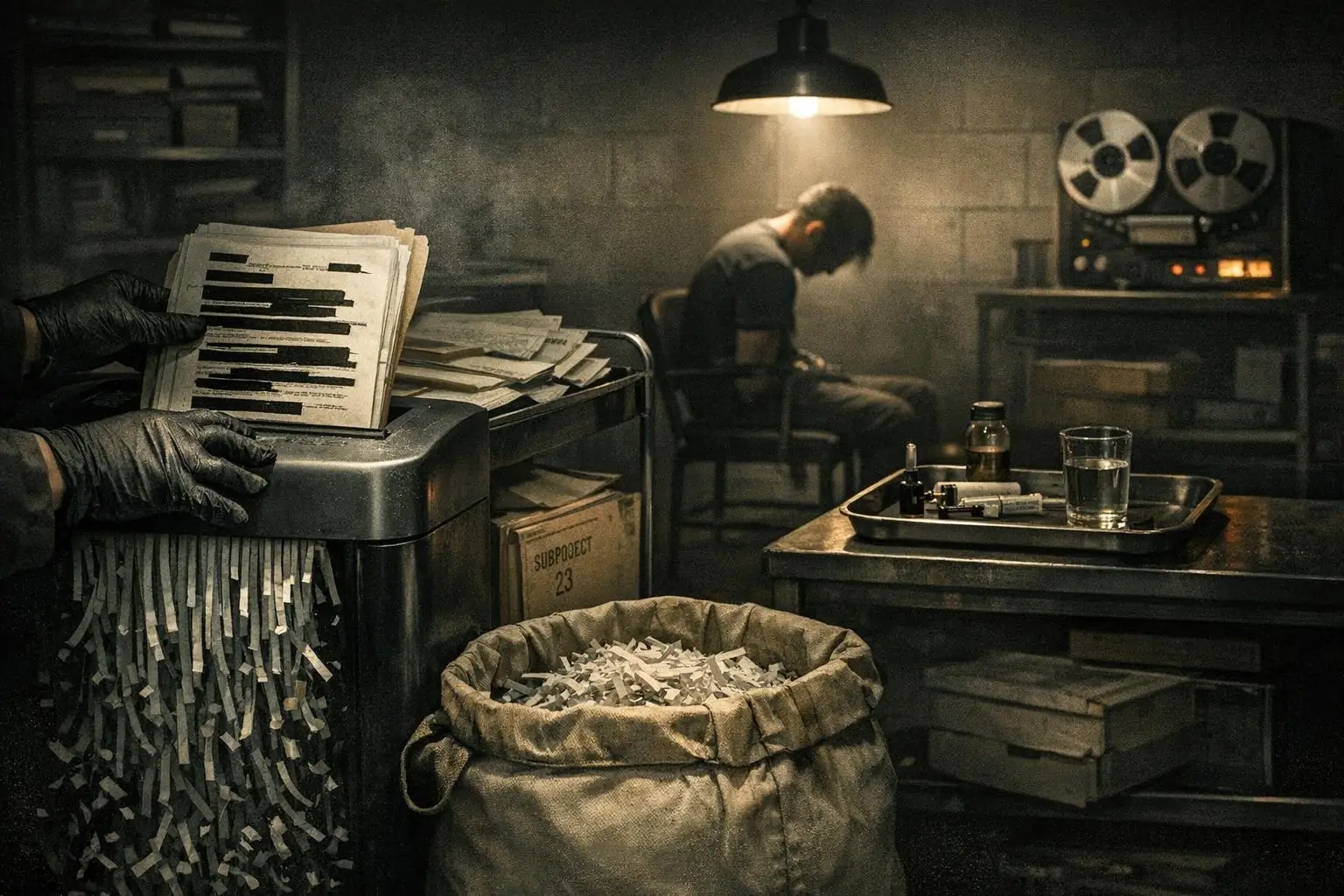
In 1973, the record preserves that CIA Director Richard Helms directed the destruction of a substantial portion of MKULTRA operational files.
Official descriptions of what remains emphasize that investigators were left mainly with financial and administrative papers. That boundary matters because it prevents reconstruction of a complete list of experiments, locations, and subjects from CIA holdings alone.
The archive can still certify that MKULTRA existed, that it operated through many subprojects, and that some methods are documented. It cannot certify the outer perimeter of activity that would have been visible inside the destroyed operational files.[4]
How MKULTRA entered public oversight: Rockefeller Commission and the Church Committee record
The brief surviving record also preserves a delayed transition into oversight, with public knowledge emerging in the mid-1970s through press reporting and then formal inquiry.
An executive-branch investigation is preserved in the Rockefeller Commission report on CIA activities within the United States. A legislative investigation framework is preserved through summaries and histories of the Church Committee.
These inquiries can certify that MKULTRA-era practices became subject to formal review. They do not remove the earlier archival damage, because the destruction of operational files constrains what any later investigation could examine.[6][7][8]
What cannot be certified about subjects and long-term outcomes
Across official inquiries and later archival compilations, the surviving emphasis is on program structure, methods, and oversight, not on longitudinal tracking of subjects.
The record is weak on systematic long-term health and psychological outcomes for most individuals connected to MKULTRA experiments. That absence blocks aggregate statements about longer-run consequences from being certified from these sources alone.
What remains open is not a single missing detail but a missing category of documentation: follow-up records tied to identifiable subjects across time.[9]
Where certification ends for MKULTRA
The surviving record can still answer part of the opening question. It can certify MKULTRA as a named CIA program, approved in 1953, aimed at behavioral modification and chemical interrogation research involving human subjects.
It can also certify scale and distribution in approximate form, including more than 130 subprojects across multiple kinds of institutions in the United States. It can certify documented methods, including LSD and other psychoactive drugs, sometimes administered without a subject’s knowledge.
Certification stops for a concrete reason preserved on the record. The 1973 destruction of many operational files leaves later readers with administrative and financial traces rather than a full operational account.
Because of that break, the archive does not stabilize a full list of experiments, locations, or subjects, and it does not preserve systematic long-term outcome data for most individuals. The open question is not whether MKULTRA existed, but how much of its lived footprint was never retained in surviving documentation.[4]
FAQs (Decoded)
Was MKULTRA a real CIA program or a later label?
The surviving record preserves MKULTRA as a named CIA program described in declassified CIA materials and in later United States Senate proceedings. Source: CIA, MKULTRA overview document.
When does the record place MKULTRA in time?
The record places formal approval in 1953 and indicates that most projects were discontinued in the early 1960s, while noting related later activity under other authorizations. Source: CIA, MKULTRA overview document.
How large was MKULTRA according to surviving documentation?
Surviving descriptions commonly preserve a scale of more than 130 research programs, but totals vary across official and archival sources and no single counting method is stabilized. Source: CIA, MKULTRA compilation document.
Does the record document LSD use on unwitting people?
Yes, the record includes descriptions of LSD and other psychoactive drugs administered to human subjects, including covert administration to unwitting individuals, within MKULTRA-related research. Source: United States Senate, MKULTRA hearing transcript.
Why are so many details missing from MKULTRA accounts?
The record preserves that many operational files were destroyed in 1973, leaving investigators with mainly financial and administrative papers rather than full operational reporting. Source: United States Senate, MKULTRA hearing transcript.
What do official investigations add, and what do they not close?
They certify that MKULTRA-era practices entered formal review, but they do not close gaps created by missing operational files and limited subject follow-up documentation. Source: Ford Library Museum, Rockefeller Commission report.
This file belongs to the real conspiracies archive. Related behavioral research program records are indexed in the same corridor. For earlier documentation in this program line, see project artichoke program records.
Sources Consulted
- CIA Reading Room, MKULTRA Subproject 68 FOIA file. cia.gov, accessed 2025-02-07
- CIA Reading Room, MKULTRA overview document. cia.gov, accessed 2025-01-31
- CIA Reading Room, MKULTRA compilation document. cia.gov, accessed 2025-01-24
- United States Senate, MKULTRA hearing transcript. intelligence.senate.gov, accessed 2025-01-17
- PubMed Central, peer-reviewed article on Donald Ewen Cameron and MKULTRA. pmc.ncbi.nlm.nih.gov, accessed 2025-01-10
- Ford Library Museum, Rockefeller Commission report PDF. fordlibrarymuseum.gov, accessed 2025-01-03
- Levin Center, overview of the Church Committee. levin-center.org, accessed 2024-12-27
- United States Senate, official history of the Church Committee. senate.gov, accessed 2024-12-20
- National Security Archive, CIA behavior control experiments collection. nsarchive.gwu.edu, accessed 2024-12-13

A Living Archive
This project is never complete. History is a fluid signal, often distorted by those who record it. We are constantly updating these files as new information is declassified or discovered.