Project Blue Beam: What the Records Show and Where They Stop
What can declassified U.S. records still certify about Project Blue Book, and what can they not certify about Project Blue Beam?
This article follows the provided institutional record where it is stable, and marks the exact points where the record cannot carry the Blue Beam claim.
- Name collision: Blue Beam vs Blue Book
- No NASA program record for Blue Beam in this input set
- NASA TechPort uses holographic terms inside bounded R&D projects
- NSF describes research that can simulate virtual images
- Northwoods memo preserves deception proposals, not an executed operation
These points define the stable edge of certification in the supplied sources, and everything beyond them stays unconfirmed here.
The NARA research page that classifies Project Blue Book files as accessible records
A researcher reaches a U.S. National Archives page dedicated to Air Force UFO records. The page functions as a guide to what exists and where it can be examined.
The page places Project Blue Book inside a research pathway rather than a narrative. It directs attention to records that can be requested and reviewed.

On that page, the files are described as declassified and available for examination. This is a status statement, not a claim about the content being complete.
The same page notes that the project closed in 1969. The closure appears as an administrative endpoint, with no additional operational detail attached.
No budgets, directives, or operational mechanisms are presented on the page itself. The object on the screen is a locator, not an origin story.
The concrete administrative act preserved here is the Archives stating access status and closure status for a defined record set.[1]
This page can certify where the Blue Book record set is positioned and how its access status is described, but it does not certify any separate entity called Project Blue Beam. The next question is what Blue Book officially was.
The U.S. Air Force fact sheet that fixes what Project Blue Book means in the record
The U.S. Air Force fact sheet defines Project Blue Book as a program that investigated reports of unidentified flying objects from 1947 to 1969.
This stabilizes one specific term, Blue Book, as an Air Force investigation program with a defined span. It does not create any bridge from that term to the internet label Blue Beam.
The next unresolved point is how the Air Force described the end of UFO investigations, because some retellings treat the end as a transition into something else.[2]
The USAF PDF that ties discontinuation to evaluating a university study, not to a new covert program
A separate U.S. Air Force fact sheet PDF frames the decision to discontinue UFO investigations as based on evaluating a study titled Scientific Study of Unidentified Flying Objects.
That is a closure rationale in public language, and it is the only closure mechanism certified in this input set. The PDF does not describe follow-on operations, and it does not mention holograms or a simulated alien invasion.
The next question is direct and narrow: if Project Blue Beam is presented as a NASA operation, where is the NASA-side documentary object that establishes it as a program?[3]
What this source set cannot locate: any NASA object called Project Blue Beam
The provided sources include U.S. Air Force and U.S. National Archives material for Blue Book, and they include NASA TechPort pages for specific technology projects.
Within that perimeter, no document establishes Project Blue Beam as a NASA program, directive, budget line, contract, or official operation. The gap is a record problem, not a resolved conclusion about what exists elsewhere.
The next step inside this constrained archive is to examine what the NASA material actually says when it uses the word holographic, because that term is often used as a shortcut for sky-scale claims.
NASA TechPort and the phrase holographic in a waveguided see-through display project
NASA TechPort includes a project titled Holographic Waveguided See-Through Display. It is framed around lightweight displays, including suit-mounted contexts.
That use of holographic is anchored to display hardware and a bounded engineering goal. It does not certify any planetary or skywide projection system.
The next question is whether NASA TechPort contains any project wording that moves from displays toward projection language, because that is where many retellings attach meaning.[4]
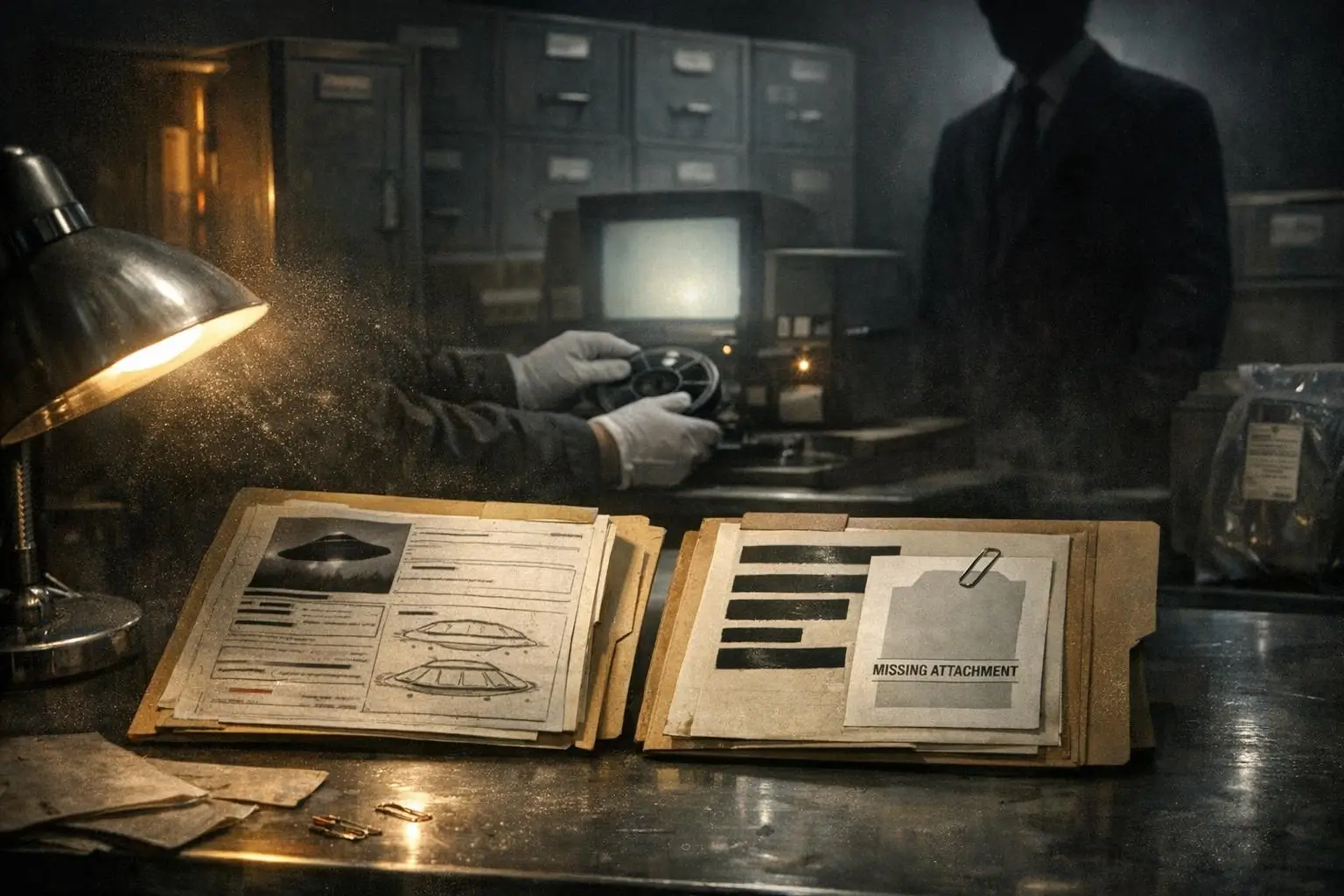
NASA TechPort and a proposal described as a programmable holographic projection and detection system
NASA TechPort also lists a proposal described as developing a programmable holographic projection and detection system.
This certifies that the term holographic projection appears in NASA project documentation in at least one discrete proposal description. It still does not certify scale, deployment context, or use as a mass public event.
The next question is what adjacent research says about creating images that appear in space, because that is sometimes blended into claims about sky holograms.[5]
The NSF description of research that can simulate virtual images
The National Science Foundation describes research demonstrating the ability to simulate virtual images using a time-varying perspective projection approach.
This provides a bounded reference for what image simulation can mean in real research language. It does not certify feasibility for the scale implied by a global fake invasion narrative.
The next question concerns another frequently invoked system, HAARP, and what it claims to be doing in its own institutional description.[6]
HAARP and the limit set by its own institutional purpose statement
HAARP describes itself as a scientific endeavor aimed at studying the properties and behavior of the ionosphere.
That statement is a scope boundary in this input set. It does not certify a projection mission, and it does not supply a mechanism for skywide imagery.
The next question shifts from technology claims to institutional behavior: is there any documented example of proposed deception operations that can be cited without turning it into a template?[7]
The Operation Northwoods memorandum as a preserved example of proposals, not execution
The National Security Archive hosts a declassified memorandum known as Operation Northwoods. In this input set, it stands as documentary evidence that deception operations could be proposed inside government planning channels.
The file remains a proposal artifact, and the brief requires it to be kept in a Cuba context. It does not certify that such proposals became policy, and it does not connect itself to UFOs, NASA, or any hologram scenario.
The next question is how to handle claims framed as psychological warfare when the available material is a different category of record.[8]
A separate documentary category: National Security Archive coverage of behavior-control experiment records
The National Security Archive provides a curated overview that points to documented behavior-control experiment records.
This can certify that a body of records exists and is being organized for scholarly focus in that archive context. It does not certify any link between those records and the Blue Beam allegation set.
The next unresolved point is attribution, because many summaries attach Project Blue Beam to a single named source without primary publication metadata in this input set.[9]
The Serge Monast attribution gap that this input set cannot close
Many retellings attach Project Blue Beam claims to Serge Monast. This brief flags a specific limitation: no primary Monast text, bibliographic record, or archived copy is included in the provided material.
That absence prevents pinning what was originally written versus what was later added through repetition. It also blocks basic verification steps, such as exact title, publication date, and stable quotations.
The next question therefore stays procedural: without a primary text object inside this source set, what can be evaluated is only the surrounding institutional record, not the alleged core document.
Where certification stops on the Blue Beam claim-space
The opening question asks for a split between what documents can still certify and what they cannot carry.
This input set can certify Project Blue Book as a U.S. Air Force UFO investigation program, and it can certify that the U.S. National Archives describes its records as declassified and available, with closure noted in 1969.
This same set can certify that NASA TechPort uses holographic terms inside specific R&D descriptions, and that NSF describes research that can simulate virtual images.
Certification stops before any claim that a NASA program called Project Blue Beam exists, before any feasibility finding for skywide holograms at the implied scale, and before any verified quotation from the alleged originating text.
Those are not interpretive gaps inside these documents; they are missing documentary objects in the supplied perimeter.[1]
FAQs (Decoded)
Is Project Blue Beam documented as a NASA program in these sources?
No validated document in this input set establishes a NASA program, directive, or contract called Project Blue Beam. Source: NASA TechPort, project documentation pages.
What is Project Blue Book in the official record here?
It is documented as a U.S. Air Force program that investigated UFO reports from 1947 to 1969. Source: U.S. Air Force, Project Blue Book fact sheet.
Do the NASA TechPort holographic projects describe skywide holograms?
No. The cited TechPort entries document bounded R&D contexts, including displays and a proposal using projection language, without certifying sky-scale use. Source: NASA TechPort, project documentation pages.
What does the NSF item certify about images in air?
It certifies that research is described as able to simulate virtual images using a time-varying projection approach, without scaling claims to global projections. Source: National Science Foundation, research news release.
What does HAARP say it is for, in its own description?
It describes itself as a scientific endeavor aimed at studying ionospheric properties and behavior. Source: HAARP, institutional about statement.
What does Operation Northwoods add to the record, and what does it not add?
It adds a documented example of proposed deception operations preserved as a memorandum, but it does not certify execution or any connection to UFO or hologram claims. Source: National Security Archive, Operation Northwoods memorandum PDF.
For more documentation corridors on record-limited allegations, explore the real conspiracies archive and the government cover-ups files. Related case files include the operation northwoods memorandum file and operation mockingbird program records.
Sources Consulted
- U.S. National Archives, Project Blue Book UFO records research page. archives.gov, accessed 2025-02-17
- U.S. Air Force, Unidentified Flying Objects and Air Force Project Blue Book fact sheet. af.mil, accessed 2025-02-10
- U.S. National Security Agency, USAF fact sheet PDF on UFO investigations. nsa.gov, accessed 2025-02-03
- NASA TechPort, Holographic Waveguided See-Through Display project page. techport.nasa.gov, accessed 2025-01-27
- NASA TechPort, Programmable holographic projection and detection system project page. techport.nasa.gov, accessed 2025-01-20
- National Science Foundation, news release on simulating virtual images. nsf.gov, accessed 2025-01-13
- HAARP, About statement on program purpose. haarp.gi.alaska.edu, accessed 2025-01-06
- National Security Archive, Operation Northwoods memorandum PDF. nsarchive2.gwu.edu, accessed 2024-12-30
- National Security Archive, briefing book overview on behavior-control experiment records. nsarchive.gwu.edu, accessed 2024-12-23

A Living Archive
This project is never complete. History is a fluid signal, often distorted by those who record it. We are constantly updating these files as new information is declassified or discovered.