COINTELPRO: What the Official Records Show—and Where They Stop
What can today’s oversight pages and disclosed PDFs still certify about COINTELPRO, and what do they no longer let us certify?
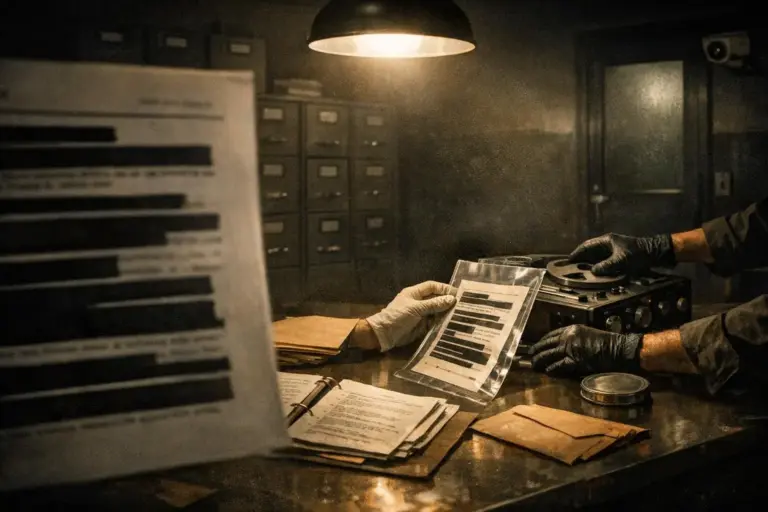
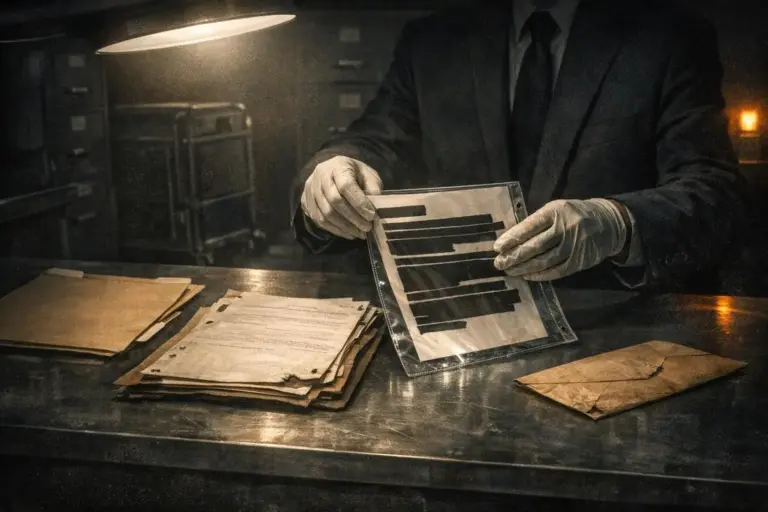
This record set preserves oversight framing, a disclosure trace, and later scrutiny language, but it does not preserve the core operational file.
- Church Committee oversight frame for intelligence abuses across agencies
- Fall 1973 DOJ disclosure line about FBI ‘counterintelligence’ program documents
- November 1, 1975 line naming William C. Sullivan in FBI domestic intelligence role
- Ordered FBI file searches for burglaries, wiretaps, and other intelligence-type activities
- UC Berkeley acquisition notice for a digital database of FBI surveillance records
These points mark the stable edge of certification in the provided sources, and anything beyond them is not stabilized here.
The Ford Library PDF folder labeled with COINTELPRO and a Fall 1973 DOJ disclosure sentence
A researcher opens an archival PDF in the Ford Library online collection and lands in a folder context that includes COINTELPRO in its labeling.
The page does not arrive as an FBI directive. It arrives as a later-preserved administrative trace, written in a way that points to document handling rather than field action.

One sentence is presented as a dated disclosure statement: In Fall, 1973 the Department of Justice disclosed cer- tain documents relating to a ‘counterintelligence’ program of the Federal Bureau of Investigation …
The sentence stops where documentary specificity would normally begin. It does not enumerate which documents were disclosed, and it does not stabilize how complete that disclosed set was.
Within this PDF, the disclosure line functions like a hinge in the surviving record. It confirms that a Justice Department disclosure event is being referenced, while leaving the contents of the disclosure unlisted in the excerpted language.
The result is a certified date-marked phrasing, paired with a hard silence on scope inside the same visible line.[1]
This artifact can certify the existence of a dated DOJ disclosure statement about FBI ‘counterintelligence’ program documents, but it cannot certify what the disclosed documents contained; the next question is what other primary releases preserve internal follow-up language.
A NARA JFK release excerpt that records an ordered search for burglaries and wiretaps
A separate primary PDF excerpt preserves one line of institutional response language: FBI officials across the nation have been ordered to search their files for new information about burglaries, wiretaps and other intelligence- …
The excerpt supports the existence of an order to conduct file searches. It does not, in the provided snippet, tie that order to COINTELPRO by name, and it does not report what the searches produced.
The unresolved point is the missing surrounding context: who issued the order in the full document, and what documentary trail followed from the search request.
A second NARA JFK release excerpt that fixes William C. Sullivan to November 1, 1975
Another released PDF excerpt preserves a name-and-date line: On November 1, 1975, William C. Sullivan, former Assistant Director, Domestic Intelligence Division, Federal Bureau of Investigation …
This stabilizes that the record set contains an oversight-era reference to a former FBI domestic intelligence official on that date. The excerpted line does not, by itself, certify what topic he was addressing in the surrounding text, and it does not certify a direct COINTELPRO operational link in the snippet provided here.
The next unresolved step is documentary, not interpretive: the surrounding pages are required to determine what question the name-and-date line was attached to in that release.

The Church Committee overview page as a documented oversight baseline
The U.S. Senate overview page provides a stable oversight frame in a single sentence: The Church Committee investigated and identified a wide range of intelligence abuses by federal agencies, including the CIA, FBI, Internal Revenue Service, and …
This confirms that congressional oversight is documented as covering intelligence abuses across multiple federal agencies. In the provided source set, the oversight material is an overview page, not report PDF pages, so precise committee wording about COINTELPRO findings cannot be quoted beyond what the overview itself states.
The unresolved question is a page-level one: which passages in the committee record address FBI domestic intelligence programs in terms that can be cited directly.
Tactics language that survives here only as a curated exhibit description
A Columbia University Libraries exhibit page provides bounded tactics vocabulary: FBI agents used dirty tricks, such as sending fake letters to people’s …
In this source set, that phrasing must remain exhibit-attributed description. It cannot be converted into proof of specific actions in specific cases, because no Tier-1 operational memorandum is provided here to match the exhibit wording.
The open documentary need is the missing primary file that would allow tactics to be stated at operational specificity rather than as curated summary language.
One bounded case reference: the King Institute statement linking COINTELPRO to Martin Luther King Jr.
The King Institute reference page contains a single COINTELPRO-linked contextual statement about an individual case: Under the FBI’s domestic counterintelligence program (COINTELPRO) King was subjected to various kinds of FBI surveillance …
This supports that an institutional reference page explicitly uses COINTELPRO terminology in connection with Martin Luther King Jr. The statement, as provided here, does not enumerate dates, methods, specific documents, or outcomes, and the source set does not include validated court records to extend the claim into incident detail.
The next unresolved task is file-specific: locating authenticated FBI records or court-certified documents that can be cited at the same level of detail that the statement implies but does not supply.
A present-tense access marker: UC Berkeley Library and a digital FBI surveillance records database
UC Berkeley Library records a current access fact in a single sentence: The Library acquired a digital database of FBI records on the surveillance of African Americans throughout the 20th century.
This can certify that a repository publicly announces custody of a digital database described in those terms. The announcement does not, in the provided line, describe the internal contents, indexing, or which programs appear within the database.
The unresolved next step is practical and document-bound: determining what the acquired database actually contains, and whether it includes COINTELPRO-labeled material that can be cited directly.
A government abstract record that points to secondary literature, not operational files
The Office of Justice Programs NCJRS entry functions as a bibliographic pointer to secondary literature on the FBI domestic counter-intelligence program.
In this source set, that pointer can certify that a titled work is indexed in a government abstract record. It cannot certify operational details, because an abstract record is not the underlying FBI documentation.
The unresolved question is acquisition and verification: obtaining the referenced work and separating its citations from primary materials that can be quoted directly.
Where the certification stops in this source set
The opening question turns on a simple constraint: this set preserves oversight and disclosure files, but it does not preserve the program’s core directive record.
What can be certified here is limited and concrete: an official Senate overview that identifies intelligence abuses across agencies, a Ford Library PDF sentence that records a Fall 1973 DOJ disclosure of FBI ‘counterintelligence’ program documents, and NARA excerpts that preserve scrutiny-era language and a dated reference to William C. Sullivan.
What cannot be certified here is equally concrete: program-wide objectives, official date bounds, enumerated tactics as written in an FBI directive, or case-level outcomes tied to specific field actions.
Certification stops for documented reasons in this brief: no directly citable Tier-1 primary FBI COINTELPRO memorandum is present, the Church Committee material is not provided as report PDF pages, no Tier-1 DOJ or FBI policy reform document is present, and no validated court records are included to stabilize case-level claims.[2][1][3][4][5][6][7][8]
FAQs (Decoded)
What does the Church Committee source certify in this article?
It certifies that a Senate investigation identified a wide range of intelligence abuses by federal agencies, including the CIA, FBI, and Internal Revenue Service, as stated on the overview page. Source: U.S. Senate, Church Committee overview page.
What is the certified Fall 1973 wording about document disclosure?
The Ford Library PDF preserves a sentence stating that, in Fall 1973, the Department of Justice disclosed certain documents relating to an FBI ‘counterintelligence’ program, with the excerpt ending before it lists the documents. Source: Gerald R. Ford Presidential Library and Museum, archival PDF excerpt.
Do the provided NARA JFK excerpts, by themselves, certify COINTELPRO operations?
No, the provided snippets certify scrutiny-era language and a dated reference, but they do not stabilize COINTELPRO operational attribution in the excerpted lines presented here. Source: National Archives, JFK Assassination Records Collection release PDFs.
How should the Columbia exhibit tactics line be used?
It can be used only as exhibit-attributed tactics vocabulary, because the source set does not include a Tier-1 operational memo that would let the same claim be made as primary documentation. Source: Columbia University Libraries, exhibit page.
What does the King Institute page allow you to say about Martin Luther King Jr. and COINTELPRO?
It allows a bounded statement that the page explicitly links COINTELPRO terminology to FBI surveillance of King, without certifying dates, methods, or outcomes in this source set. Source: The Martin Luther King, Jr. Research and Education Institute, FBI reference page.
What is the documented access point for FBI surveillance records mentioned here?
The UC Berkeley Library announcement certifies that it acquired a digital database of FBI records described as covering surveillance of African Americans throughout the 20th century, without detailing contents in the provided line. Source: UC Berkeley Library, news release.
The classified case files archive preserves additional oversight-adjacent documentation, including operation mockingbird records that continue the same cabinet of named program file trails referenced in later institutional records.
Sources Consulted
- Archival PDF in a folder context referencing COINTELPRO and a DOJ disclosure sentence. fordlibrarymuseum.gov, accessed 2025-02-06
- Church Committee overview page. senate.gov, accessed 2025-01-30
- JFK Assassination Records Collection release PDF. archives.gov, accessed 2025-01-23
- JFK Assassination Records Collection release PDF. archives.gov, accessed 2025-01-16
- Exhibit page. exhibitions.library.columbia.edu, accessed 2025-01-09
- FBI reference page. kinginstitute.stanford.edu, accessed 2025-01-02
- News release. lib.berkeley.edu, accessed 2024-12-26
- NCJRS abstract record. ojp.gov, accessed 2024-12-19
A Living Archive
This project is never complete. History is a fluid signal, often distorted by those who record it. We are constantly updating these files as new information is declassified or discovered.