Reichstag Fire False Flag: Where the Surviving Record Stops
What can the surviving record certify about 27 February 1933 and its legal aftermath, and where does attribution permanently stop?
This case survives as a small chain of dated institutional summaries and curated documents, with key primary texts missing from this set.
- 27 February 1933 Reichstag building burned, treated as arson
- Emergency decree suspended speech, press, assembly; due process curtailed
- Fire trial verdict: Marinus van der Lubbe guilty; other defendants acquitted for insufficient evidence
- Enabling Act mechanism: Reich government could issue laws without parliament’s consent
- Scholarship dispute: whether van der Lubbe acted alone remains contested
These points mark the stable edge of what this source set can certify without pushing past the record.
Evidence gate: the USHMM timeline entry for the Reichstag Fire Decree
A timeline entry labeled Reichstag Fire Decree appears in the United States Holocaust Memorial Museum encyclopedia. It presents the decree as a dated state action.
The entry places issuance on February 28, 1933. It identifies President Paul von Hindenburg as the issuer.
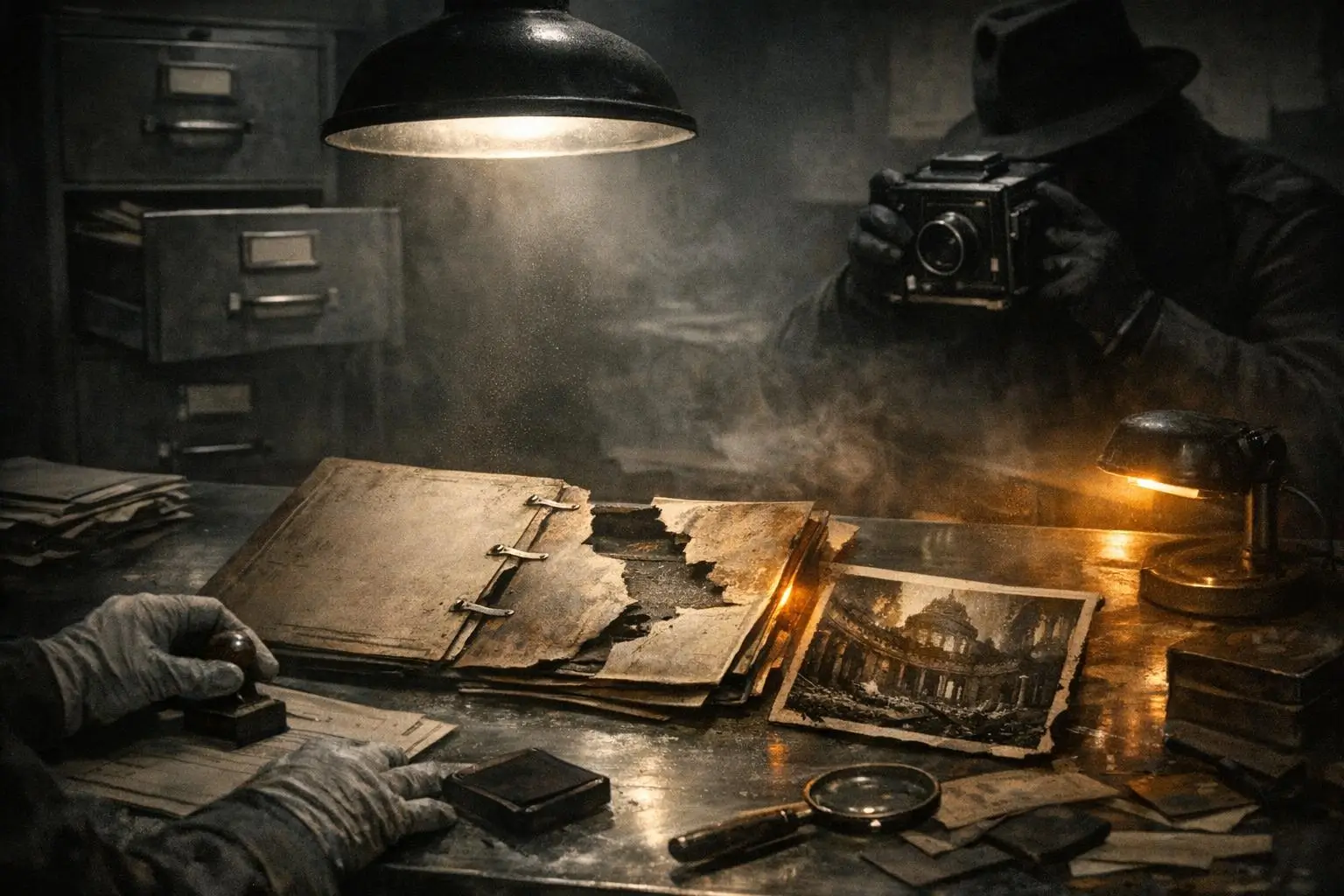
The entry uses Reichstag Fire Decree as a common label. It frames the instrument as an emergency decree.
The entry sits as a compact index point, not a full legal reproduction. It appears as part of a chronological sequence of events.
The entry does not supply the full decree text in this setting. It therefore cannot carry provision-level language inside this provided set.
This timeline object is enough to lock an issuer and a date, and nothing more.[1]
This entry can certify who issued the decree and when, but it does not certify the full legal wording; the next question is what rights summaries say were suspended.
The USHMM encyclopedia entry that fixes the fire date and the arson framing
The USHMM encyclopedia entry on the Reichstag fire fixes the initiating event to February 27, 1933. It records that the fire was treated as arson.
The same entry ties the aftermath to an emergency decree that suspended key civil liberties. The documented categories include freedoms of speech, press, and assembly, with due process protections curtailed.[2]
This source set preserves the event date and high-level rights categories, but it does not include the primary decree text that would stabilize exact legal provisions.
A curated defendant list: GHDI’s document on the accused in the arson trial
The curated primary document titled The Accused in the Reichstag Arson Trial lists named defendants as of September 1, 1933. In this set, it anchors the cast as Marinus van der Lubbe, Ernst Torgler, Georgi Dimitrov, and other defendants.
This list can certify who was formally accused within that curated frame. It cannot certify who planned, assisted, or executed the fire, because it is not a trial transcript or a judgment text.
The next unresolved step is how the court outcome is recorded in institutional summaries, and what those summaries do and do not explain.[3]
The USHMM trial summary that fixes conviction, acquittals, and the stated evidentiary boundary
The USHMM summary of the Reichstag fire trial records a specific outcome. It states that the German Supreme Court found Marinus van der Lubbe guilty.
The same summary records that the other defendants were acquitted. It attributes those acquittals to insufficient evidence of their involvement.
This set can hold that verdict structure, but it cannot carry detailed evidentiary reasoning because the primary judgment and certified transcripts are not included here.[4]

The Enabling Act mechanism as preserved in the USHMM institutional summary
The USHMM entry on the Enabling Act preserves a defined legal mechanism. It states that the act allowed the Reich government to issue laws without the consent of Germany’s parliament.
The same entry describes this as a legal foundation for Nazification of the state. Within this set, that is the maximum stable description of the transfer mechanism.
This record does not include the legislative text or an implementation file that would show how specific laws were produced and applied over time.[5]
Where responsibility stops: historiographical dispute and missing primary texts
A peer-reviewed historiographical treatment in this set records sustained disagreement about attribution. It preserves that scholarship continues to dispute whether van der Lubbe acted alone or whether others were involved.
This matters because the trial outcome, as summarized here, does not settle the wider interpretive dispute. The disagreement is treated as historiography rather than a closed factual question in this source set.
The limits are concrete inside the provided materials. The primary text of the emergency decree is not present here, and the primary court judgment or transcripts are also not present here, so this set cannot certify provision-level language or evidentiary detail.
The next retrieval problem is narrow and technical: obtain a citation-grade copy of the decree text and a citation-grade copy of the court decision or transcripts, then reassess what can be stabilized.[6]
When the term ‘false flag’ outruns the surviving record
The opening question asks for a boundary between certification and loss. In this set, the certified chain is a dated fire treated as arson, followed by a dated emergency decree, followed by later legal and judicial summaries.
This set can also certify that key civil liberties were suspended in documented categories, and that due process protections were curtailed. It can certify a trial outcome in which van der Lubbe was convicted and other defendants were acquitted for insufficient evidence of involvement.
What it cannot certify is a settled attribution story that resolves the dispute about whether van der Lubbe acted alone. It also cannot certify the decree’s exact legal language or the court’s detailed reasoning, because those primary texts are not included in the provided materials.
That is the point where labels such as ‘false flag’ become untestable inside this archive slice. The record can hold mechanisms and dates, and it stops where primary legal text and primary court records are missing.[6]
FAQs (Decoded)
What does this source set certify about the Reichstag fire itself?
It certifies that the Reichstag building burned on February 27, 1933, and that the fire was treated as arson in the institutional summary used here. Source: United States Holocaust Memorial Museum, encyclopedia article The Reichstag Fire.
Who issued the Reichstag Fire Decree in this record set?
This set certifies that President Paul von Hindenburg issued an emergency decree on February 28, 1933, commonly known as the Reichstag Fire Decree. Source: United States Holocaust Memorial Museum, timeline entry Reichstag Fire Decree.
Which civil liberties are documented as suspended in the summaries provided?
The documented categories include freedoms of speech, press, and assembly, and the summaries also state that due process protections were curtailed. Source: United States Holocaust Memorial Museum, encyclopedia article The Reichstag Fire.
What does this set say about the Reichstag fire trial outcome?
It records that the German Supreme Court found Marinus van der Lubbe guilty and acquitted the other defendants due to insufficient evidence of their involvement. Source: United States Holocaust Memorial Museum, film and entry Reichstag fire trial.
What change does the Enabling Act certify in this set?
It certifies a mechanism in which the Reich government could issue laws without the consent of Germany’s parliament, described as a legal foundation for Nazification of the state. Source: United States Holocaust Memorial Museum, encyclopedia article The Enabling Act.
Is it settled here whether van der Lubbe acted alone?
No, this set preserves that scholarship continues to dispute whether he acted alone or whether others were involved, and it treats that question as historiography rather than a resolved fact. Source: Histoire sociale or Social History, journal article The Reichstag Fire and the Politics of History.
For additional documentation within the real conspiracies archive, see related staged incident case files including operation northwoods memo files and gulf of tonkin records.
Sources Consulted
- United States Holocaust Memorial Museum, timeline entry Reichstag Fire Decree. encyclopedia.ushmm.org, accessed 2025-02-17
- United States Holocaust Memorial Museum, encyclopedia article The Reichstag Fire. encyclopedia.ushmm.org, accessed 2025-02-10
- German History in Documents and Images, curated primary document The Accused in the Reichstag Arson Trial. germanhistorydocs.ghi-dc.org, accessed 2025-02-03
- United States Holocaust Memorial Museum, film and entry Reichstag fire trial. encyclopedia.ushmm.org, accessed 2025-01-27
- United States Holocaust Memorial Museum, encyclopedia article The Enabling Act. encyclopedia.ushmm.org, accessed 2025-01-20
- Histoire sociale or Social History, journal article The Reichstag Fire and the Politics of History. hssh.journals.yorku.ca, accessed 2025-01-13
A Living Archive
This project is never complete. History is a fluid signal, often distorted by those who record it. We are constantly updating these files as new information is declassified or discovered.