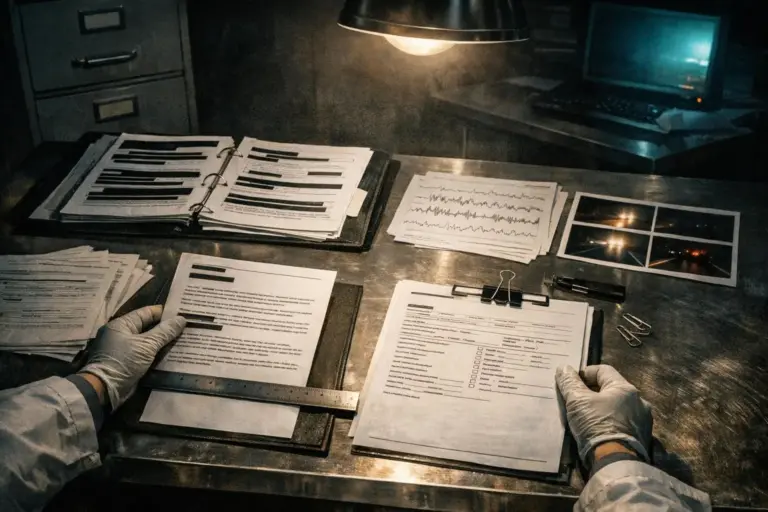
UFO Sightings: What Navy Records Show and Where They Stop
What can the official UAP record certify about Navy-linked footage and reporting, and what does it still refuse to settle?
This file stays inside the surviving, officially hosted artifacts that define what the US government record can confirm about UAP-related materials.
- AARO maintains an official UAP imagery aggregation
- ODNI defines UAP as not immediately identifiable airborne objects
- ODNI notes UAP may be observed across multiple sensor types
- ODNI says most assessment data came from US Navy reporting
- Navy standardized UAP reporting mechanism began March 2019
These points define the stable edge of certification in the provided archive, and anything beyond them is not fixed here.
AARO Official UAP Imagery, treated as an index artifact
An administrative act occurs when an official office publishes a single page meant to gather and point to imagery under its UAP case materials.
On AARO’s Official UAP Imagery page, the page itself functions as a boundary marker between official hosting and everything that circulates elsewhere. The record here is the page’s existence and its role as an aggregation.
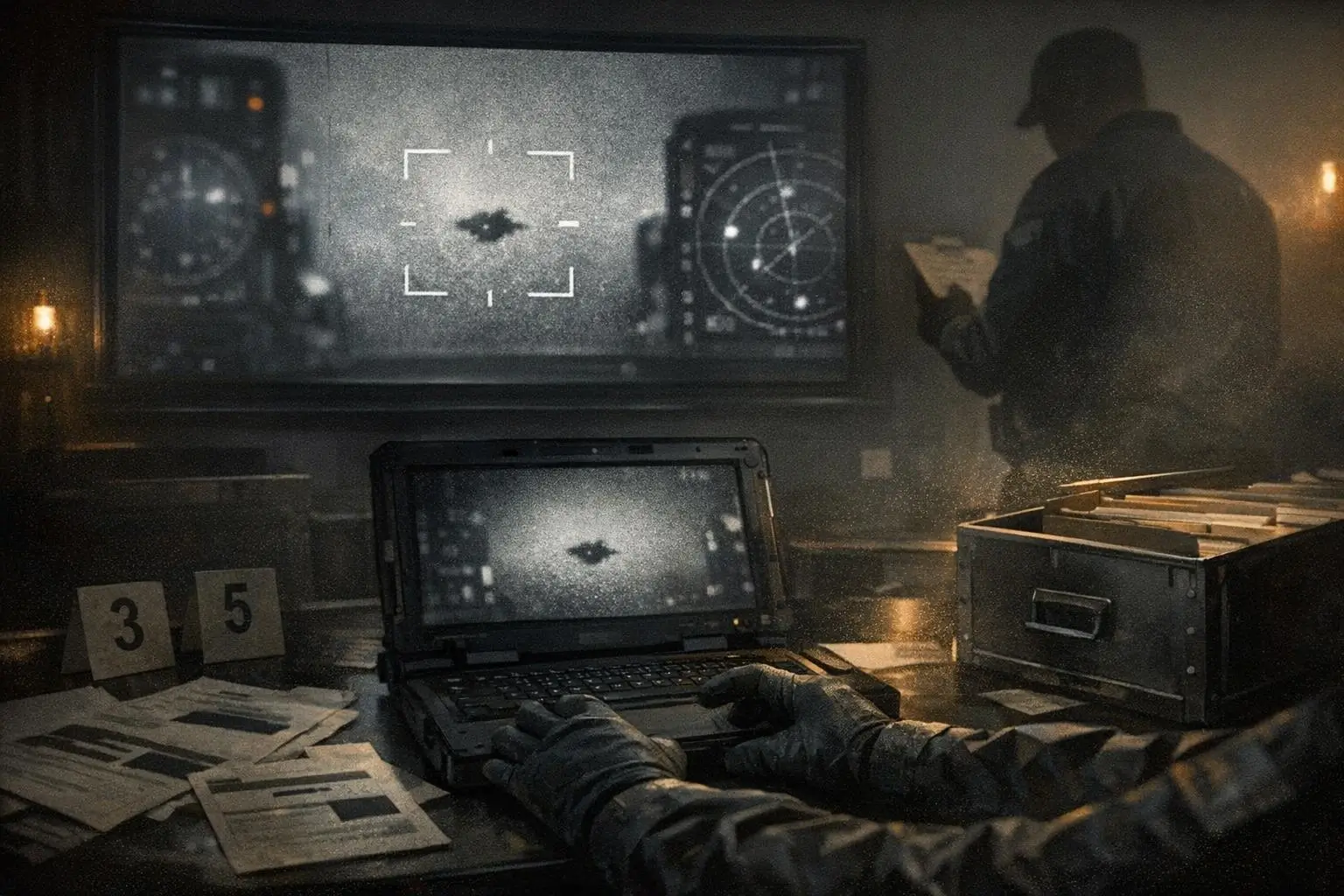
The act is not a claim about what any clip depicts, because the page does not supply a case resolution file for each item it references.
It also does not grant permission to treat reuploads as equivalent evidence, because the index is the only certified reference point in this archive. The page is a sorting tool, not a verdict.
In this setting, the page becomes a control surface for provenance: it helps separate officially posted imagery from secondary copies that may add edits, captions, or commentary.
The archive can certify that AARO publishes an official aggregation described as Official UAP Imagery, and that this page exists as an institutional index.[1]
This certifies a sanctioned index for imagery, but it does not certify identification of any object in that imagery; the next question is how the official record defines UAP in the first place.
ODNI Preliminary Assessment, where the term UAP is locked
In the ODNI Preliminary Assessment, UAP is defined as airborne objects not immediately identifiable.
The same assessment notes that UAP may be observed through multiple sensors, including radar, infrared, and optical systems.
This definition stabilizes terminology, but it does not establish what any given object was, because the term is explicitly about immediate identifiability rather than final identification.
The provided archive includes ODNI hosting and a redundant SECNAV FOIA Reading Room copy, which allows cross-checking without changing the definition.[2]
What ODNI says about where the assessment data came from
The ODNI assessment reports that most UAP data used in that assessment came from US Navy reporting.
This anchors the dataset to a service-level reporting stream, but the assessment text in this archive does not preserve a full case-by-case list inside the brief materials provided here.
What remains open, inside this constrained record, is how that predominance interacts with reporting changes that started in 2019.[3]
March 2019: the documented shift to a standardized reporting mechanism
ODNI states that no standardized reporting mechanism existed until the Navy established one in March 2019.
ODNI also states that the Air Force subsequently adopted that reporting mechanism.
This certifies a process change and a sequence, but the archive here does not include a procedural manual showing how reports were validated, triaged, or rejected under the mechanism.
The next unresolved point is not whether a mechanism existed, but which official artifacts connect that mechanism to specific videos or incident files.[2]
An officially hosted video page, separated from reuploads
The archive includes an officially hosted DVIDS page for a Navy 2019 West Coast video.
Using an official host can certify provenance of that hosted asset in a way secondary reposts cannot, because the record of hosting is preserved on an institutional release page.
That certification stops at hosting and access, because this archive does not include an AARO case resolution report tied to this specific item, and it does not include an embedded determination about what the object was.
The next unanswered question is where, in the official record set, a resolution statement would be published for a particular Navy incident.[4]

Congress.gov as a separate documentary layer: the July 26, 2023 transcript artifact
Congress.gov hosts the official record for a House Oversight hearing on UAP held July 26, 2023, including a transcript document.
This certifies that an oversight event produced a preserved, publicly accessible transcript artifact within the congressional record.
It does not supply underlying operational files for Navy encounters, because a hearing transcript is a different document class than a case file or technical resolution report.
The next question becomes which claims in a transcript can be traced to separately hosted documents actually present in this archive.[5]
Method guardrails: what the NASA report can certify, and what it cannot
The NASA UAP independent study team final report is included here as a government scientific framing document.
Within the boundaries provided in this brief, it functions as a standards reminder centered on rigorous methods and data quality for studying UAP.
That is a methodological certification, not a case resolution, and this archive does not provide NASA determinations for specific Navy incidents discussed elsewhere in public conversation.
The open issue it leaves in this constrained set is practical: what data quality is available for the specific officially hosted imagery entries, and where that metadata is stored.[6]
A bounded historical baseline: what the Air Force fact sheet says about Project Blue Book
The US Air Force fact sheet states that Project Blue Book recorded 12,618 reports, and that 701 remained unidentified.
The same fact sheet states that the Air Force discontinued investigations in 1969.
This provides an official baseline statement, but it does not connect procedurally to the Navy’s March 2019 reporting mechanism, and the archive here does not preserve a document bridging those eras.
The remaining open point is how modern UAP reporting and modern official imagery aggregation relate to earlier Air Force-era investigative framing, using only certified documents.[7]
Documentary absences that block firm language about confirmed incidents
The record provided here contains official hosting points, but it also contains two hard gaps that stop certain common claims from stabilizing.
First, the direct DoD press release dated April 27, 2020 that authenticated three Navy videos identified in the brief as FLIR1, GIMBAL, and GOFAST is not present in this archive set.
Second, AARO case resolution reports for specific Navy incidents referenced by the topic are not included in the provided materials.
Because of these absences, the archive can preserve provenance signals, but it cannot precisely separate authentic footage language from identified object language for the specific named videos, and it cannot certify current resolution status for particular incidents.[1]
Where this record stops, and what document would move it forward
The opening question asked what can be certified versus what can no longer be certified about Navy-linked UAP materials.
This archive can certify an official imagery aggregation exists, that ODNI defines UAP as not immediately identifiable airborne objects, and that the ODNI assessment relies largely on US Navy reporting with a standardized Navy mechanism beginning in March 2019.
Certification stops when the conversation turns from provenance to conclusions about specific incidents, because the direct DoD authentication press release cited in the brief is missing here, and AARO resolution reports for specific Navy incidents are also not included.
The next documentary targets are concrete: the absent DoD April 27, 2020 release, and the absent AARO UAP case resolution report documents that would allow stable status language inside an official record set.[2]
FAQs (Decoded)
For additional context on institutional documentation within this paranormal records archive, readers may consult the broader uap records corridor or review related entries such as area 51 document files and the roswell incident record file.
Sources Consulted
- AARO, Official UAP Imagery page. aaro.mil, accessed 2025-02-17
- ODNI, Preliminary Assessment: Unidentified Aerial Phenomena PDF. dni.gov, accessed 2025-02-10
- SECNAV FOIA Reading Room, Preliminary Assessment UAP PDF copy. secnav.navy.mil, accessed 2025-02-03
- DVIDS, Navy 2019 West Coast video release page. dvidshub.net, accessed 2025-01-27
- Congress.gov, HHRG-118-GO06 transcript PDF. congress.gov, accessed 2025-01-20
- NASA, UAP independent study team final report PDF. science.nasa.gov, accessed 2025-01-13
- U.S. Air Force, Project Blue Book fact sheet. af.mil, accessed 2025-01-06

A Living Archive
This project is never complete. History is a fluid signal, often distorted by those who record it. We are constantly updating these files as new information is declassified or discovered.