Area 51 Documents: What the Records Show—and Where They Stop
When a CIA file title uses Area 51, what does the declassified record certify, and where does its naming stop?
This article stays inside a small, traceable set of declassified and curated records that touch Groom Lake-era aviation programs and later secrecy posture.
- CIA Reading Room hosts an A-12 OXCART declassified document collection
- NARA/ISCAP PDF institutional history on U-2 and OXCART, 1954–1974 scope
- Sept. 29, 1995 presidential determination on classified information tied to an operating location near Groom Lake, Nevada
- National Security Archive briefing book organizes links on the U-2 and Area 51 topic
- Eisenhower Library online documents portal as an entry point for 1950s-era records retrieval
These points define the stable edge of certification available in the current anchor set, without substituting curation or commentary for primary text.
CIA-RDP81B00879R001000120175-9: the CIA Reading Room page titled REPORT ON TRIP TO AREA 51 DURING PERIOD 2
The CIA Reading Room hosts a document page whose title line reads REPORT ON TRIP TO AREA 51 DURING PERIOD 2.
On that page, the record appears with the identifier CIA-RDP81B00879R001000120175-9. The format is a public-facing posting inside the CIA Reading Room rather than a secondary retelling.
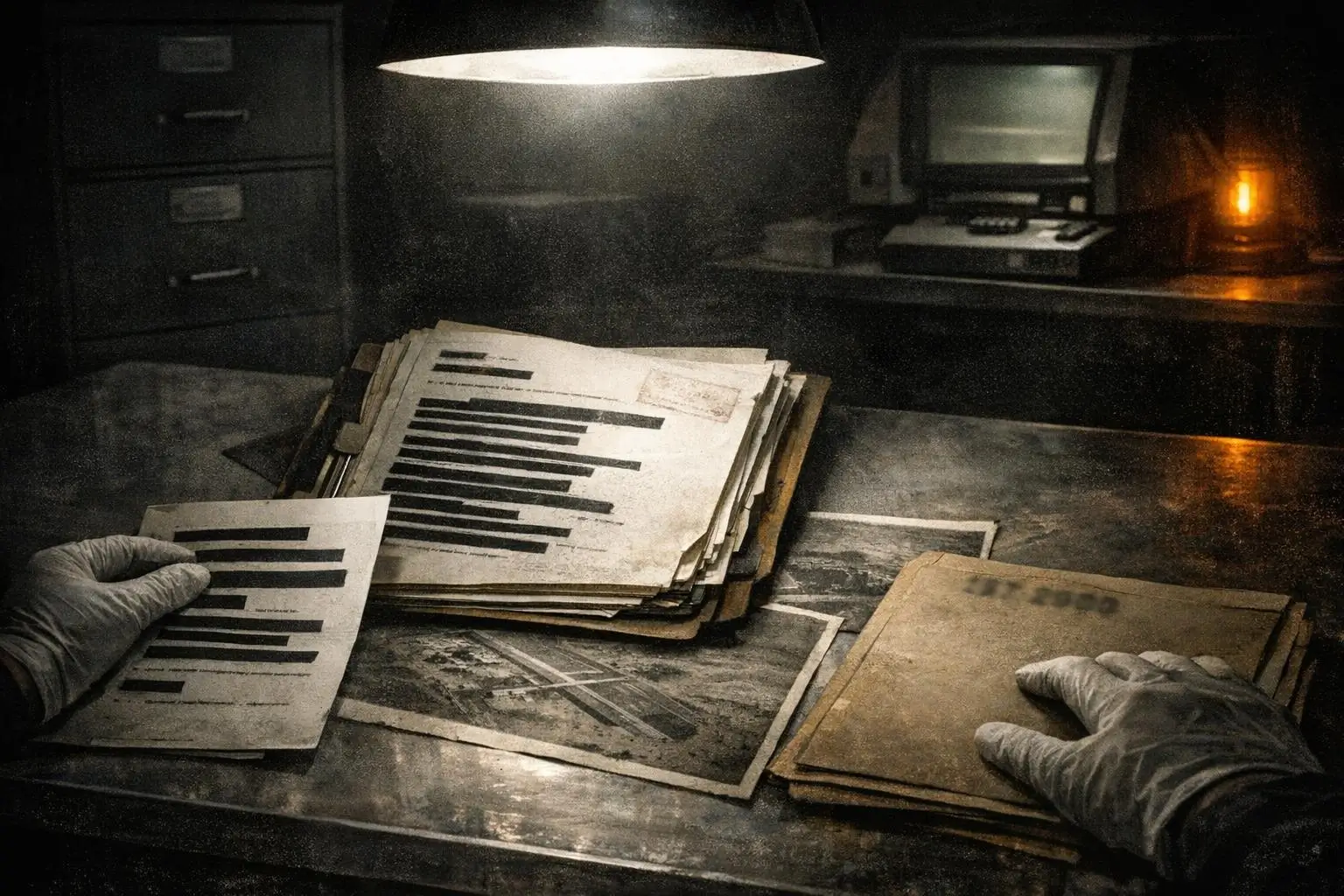
The posted page excerpt describes activities framed as ‘familiarization in the A-12’ and includes ‘a front-seat ride’. The excerpt is short and does not add surrounding operational context in the preserved line.
The excerpt also notes that flights occurred ‘with satisfactory results’. The posted line does not, by itself, stabilize what those flights were for or how results were measured.
As a declassified posting, the page certifies two things at once: the title’s use of the term Area 51 and the presence of an A-12 activity description on the same declassification artifact.
The page does not provide, in the preserved elements used here, an explicit cross-label statement tying Area 51 to other site terms or agency designations.[1]
This single record supports use of Area 51 as document-language in a CIA title and preserves a minimal activity summary, but it does not certify how other records name the same place.
Sept. 29, 1995: an executive-branch record that says operating location near Groom Lake, Nevada
A presidential determination dated September 29, 1995 addresses classified information concerning an Air Force ‘operating location near Groom Lake, Nevada’.
This anchor is later than the U-2 and OXCART era framed elsewhere in the provided set, and it uses a descriptor that differs from the phrase Area 51.
The determination text, as used here, does not supply a document-language bridge that equates its Groom Lake phrasing to the CIA trip report’s title wording. Any one-to-one mapping remains uncertified at this level.[2]
The CIA collection hub: A-12 OXCART Reconnaissance Aircraft Documentation
The CIA Reading Room hosts an official declassified collection titled A-12 OXCART Reconnaissance Aircraft Documentation. It functions as a centralized access point for program materials.
This collection page is a repository anchor, not a single narrative. It does not by itself certify which specific site labels appear across all included documents.
What it does provide is a stable institutional location to pull additional primary texts when a claim depends on exact wording rather than timeline shorthand.[3]
NARA/ISCAP institutional history: The Central Intelligence Agency and Overhead Reconnaissance, 1954–1974
A NARA/ISCAP-hosted PDF titled The Central Intelligence Agency and Overhead Reconnaissance: The U-2 and OXCART Programs, 1954–1974 exists as an institutional history covering those programs within that stated scope.
In the current anchor set, this document is used as a boundary marker for program-era coverage, not as a substitute for contemporaneous decision-chain records or site-specific naming proofs.
The early site selection and basing decision layer often associated with 1954–1956 is identified in this brief as missing from the validated material. Origins claims cannot be stabilized here.[4]

National Security Archive pages: useful indexing, weak footing for claims
The National Security Archive publishes a curated briefing book page titled The Secret History of the U-2 – and Area 51. It organizes links to declassified records relevant to the topic.
A separate National Security Archive briefing page, Area 51 File: Secret Aircraft, Soviet MiGs, also functions as a waypoint for locating declassified documents beyond a single agency collection.
These pages can guide retrieval, but their summaries are not treated as primary evidence inside this framework. Any important assertion must be rerouted to the linked declassified documents themselves.[5]
What the current anchors cannot close: naming equivalence, court text, and early decisions
The brief flags terminology drift as a persistent records problem. Documents may use labels such as Area 51, Groom Lake, Homey Airport, or generic descriptors like ‘operating location near Groom Lake’. In the validated set provided here, no document-language bridge equates these terms across agencies.
A second gap is legal-text absence in the 1990s secrecy dispute space. Reporting is present as a pointer, but court docket materials, filings, or opinions are not part of the validated materials. Legal outcomes cannot be certified from this package alone.
The Las Vegas Sun item titled Toxic data at Area 51 ruled confidential can identify which legal and administrative documents would need retrieval, but it cannot stand in for those underlying records.[6]
For the earliest decision-chain layer, the Eisenhower Library online documents portal is present only as an entry point. It does not become evidence until specific contemporaneous documents are pulled and cited by their exact text.[7]
Where the documents still certify Area 51, and where they stop
The record can certify one narrow but important point: a CIA Reading Room declassified posting uses Area 51 in the title of a specific trip report record, and it preserves a short A-12 activity description.
The record can also certify that later executive-branch language exists addressing classified information tied to an Air Force operating location near Groom Lake, Nevada, without using the same label.
Certification stops at three concrete edges in this package: no primary cross-agency statement equating site labels is provided, no 1954–1956 decision-chain documents are supplied, and no court filings or opinions are included to ground 1990s legal posture claims.
Until those missing texts are retrieved and cited by their own words, Area 51 remains, in this constrained archive view, a documented term in one CIA title line rather than a fully mapped designation across the record.[1]
FAQs (Decoded)
Is Area 51 a term that appears in a CIA declassified record title?
Yes, the CIA Reading Room hosts a declassified document page whose title line uses Area 51 for a specific trip report record. Source: CIA Reading Room, declassified document page.
Does the provided record set prove that Area 51 and Groom Lake are the same formal designation?
No, the provided anchors show different phrases in different records, but they do not include a primary text that explicitly ties the labels together. Source: CIA Reading Room, declassified document page.
What activity does the CIA trip report page excerpt preserve?
The preserved excerpt language in this brief includes ‘familiarization in the A-12’, ‘a front-seat ride’, and a note that flights occurred ‘with satisfactory results’. Source: CIA Reading Room, declassified document page.
What is the value of the CIA A-12 OXCART collection page for research?
It functions as a stable CIA-hosted hub for accessing declassified OXCART and A-12 program materials without relying on secondary timelines. Source: CIA Reading Room, A-12 OXCART collection page.
What does the NARA/ISCAP PDF certify on its own?
It certifies the existence of an institutional history document covering the U-2 and OXCART programs within a stated 1954–1974 scope, but it does not replace missing early decision-chain records. Source: National Archives and Records Administration / ISCAP, institutional history PDF.
Why is the National Security Archive briefing book not treated as primary evidence here?
Because it is a curated finding aid that organizes links, and its summaries cannot substitute for quoting the underlying declassified documents themselves. Source: National Security Archive, briefing book page.
For more on the institutional record gaps around declassified programs, explore the real conspiracies archive, the government cover-ups files, or the operation mockingbird records.
Sources Consulted
- CIA Reading Room, document page for CIA-RDP81B00879R001000120175-9. cia.gov, accessed 2025-02-17
- American Presidency Project, presidential determination page. presidency.ucsb.edu, accessed 2025-02-10
- CIA Reading Room, A-12 OXCART Reconnaissance Aircraft Documentation collection page. cia.gov, accessed 2025-02-03
- National Archives and Records Administration / ISCAP, institutional history PDF. archives.gov, accessed 2025-01-27
- National Security Archive, NSAEBB434 briefing book page. nsarchive2.gwu.edu, accessed 2025-01-20
- Las Vegas Sun, article page used as a retrieval pointer. lasvegassun.com, accessed 2025-01-13
- Eisenhower Presidential Library, online documents portal. eisenhowerlibrary.gov, accessed 2025-01-06

A Living Archive
This project is never complete. History is a fluid signal, often distorted by those who record it. We are constantly updating these files as new information is declassified or discovered.