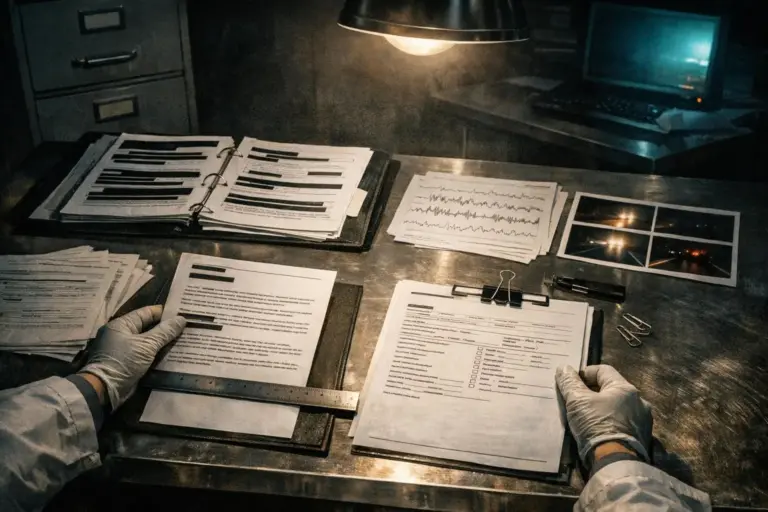
What Is Area 51: Documented Programs and Unresolved Gaps
What can a declassified CIA trip report still certify about Area 51, and what can the surviving record no longer certify?
The phrase Area 51 survives in a small set of official pages and released records, but it does not come with a complete official definition here.
- CIA FOIA Reading Room title: REPORT ON TRIP TO AREA 51 DURING PERIOD 2
- Trip excerpt: F-101 recurrency; A-12 familiarization front seat ride
- CIA Museum: A-12 OXCART developed by CIA as highly secret U-2 successor
- Nellis AFB: NTTR provides flexible, realistic and multidimensional battle-space
- USAF: Project Blue Book 12,618 reports; 701 remained ‘unidentified’
These points mark the stable edge of what the validated packet can certify without filling gaps from outside the record.
CIA FOIA Reading Room entry: REPORT ON TRIP TO AREA 51 DURING PERIOD 2
A CIA FOIA Reading Room page presents a released record under a specific document URL. The visible title line includes the term Area 51 as part of the document name.
The title reads REPORT ON TRIP TO AREA 51 DURING PERIOD 2. The packet treats that title as an on-record instance of the term inside CIA materials.

An excerpt is preserved on the same CIA page. The excerpt appears as a quoted line from the record’s text, not as a separate summary.
The excerpt states that the primary purpose of the trip was recurrency in F-101 and familiarization front seat ride in A-12. It does not add other activities in the portion preserved here.
Within this packet, that single line is the only certified description of what the trip document says about purpose. Anything beyond F-101 recurrency and an A-12 familiarization ride is not stabilized by the excerpt.
The page functions as the access point for this record and its excerpted wording, and it preserves the title language as released.[1]
This evidence gate certifies a CIA record title using the term Area 51 and a constrained description of a trip purpose. It does not certify where Area 51 is, what its administrative status is, or how the label is officially defined. The next step is to bound the aircraft context named in the excerpt.
What the CIA Museum page certifies about the A-12 named in the excerpt
The CIA Museum page states that the CIA developed the highly secret A-12 OXCART as the U-2 spy plane’s successor. That institutional sentence bounds what can be said here about the A-12 without importing external program history.
This packet does not preserve an operational link that places the CIA Museum description inside the trip report, beyond the fact that the trip excerpt mentions an A-12 familiarization front seat ride. It also does not certify that the Museum page uses the term Area 51, so the connection remains at the level of a shared aircraft reference.
The next unresolved question is how the larger training and test environment is described in official Air Force materials, without claiming that Area 51 is administratively identical with that environment.[2]
How Nellis AFB describes the Nevada Test and Training Range, and what it does not name
The Nellis AFB NTTR page states that the Nevada Test and Training Range provides the warfighter a flexible, realistic and multidimensional battle-space. That is the certified organizational language in this packet for what NTTR is described to provide.
This validated set does not include a Tier 1 statement that explicitly equates Area 51 with NTTR, or that defines Area 51 as a unit, base, or range component in plain administrative terms. Because that connective document is absent here, the NTTR description can only serve as broader range-context language, not a direct definition of Area 51.
The next question is why secret aircraft-related training appears in institutional records at all, and what those records can certify without attaching them to a specific site name.[3]
Project Constant Peg as a documented example of secret aircraft training language
The National Museum of the U.S. Air Force fact sheet states that Project Constant Peg was a secret program to train US Air Force, Navy, and Marine Corps fighter aircrews to fly against Soviet-designed aircraft. This provides a certified program definition for the kind of activity often discussed loosely as secret MiGs.
This packet does not certify where Project Constant Peg occurred, and it does not certify any administrative or geographic tie between that program and the CIA trip report that mentions Area 51. The museum fact sheet can support only the program’s stated training purpose and participant services, not a location claim.
The next question is how UFO context enters the public record in an official way, and whether this packet contains any Tier 1 bridge from UFO reporting to specific aircraft programs.[4]

Project Blue Book counts, and the missing linkage to specific flight testing in this packet
The USAF fact sheet states that, of a total of 12,618 sightings reported to Project Blue Book, 701 remained ‘unidentified’. This certifies a quantified record statement about reporting totals and the remainder that the fact sheet labels as unidentified.
What the validated set does not preserve is a Tier 1 document that connects those Blue Book reports to U-2 or A-12 testing as a documented explanation. Without that explicit linkage inside this packet, the Blue Book numbers can only be used as counts, not as evidence of causation tied to specific reconnaissance programs or sites.
The next question is where a controlled document trail about Area 51 and aircraft programs can be entered, without treating a curator’s framing as a substitute for the underlying files.[5]
The National Security Archive page as a gateway, not a final adjudicator
The National Security Archive briefing book page is presented as a curated set of declassified records about Area 51’s role in classified aircraft-related programs and includes primary-source links. In this packet, its certified role is to function as a gateway to a document trail, not as standalone proof of any single claim.
This validated set does not include the underlying linked records as separate, certified artifacts, and it does not supply a Tier 1 current administrative definition or a Tier 1 precise location descriptor tied to the term Area 51. Because those items are missing here, the gateway can point outward, but it cannot close the questions of what Area 51 is today or where it is in official plain language.
The next unresolved step is explicit: locate Tier 1 documentation that names the installation or airfield and administrative control, and locate Tier 1 records that tie the label Area 51 to a specific place name without relying on folklore.[6]
What is Area 51, where is it, and why does this packet stop short?
The record here can certify that Area 51 appears as a term in a CIA FOIA Reading Room document title, and that one excerpted line describes a trip purpose involving F-101 recurrency and an A-12 familiarization front seat ride.
It can also certify institutional context statements: the CIA developed the A-12 OXCART as a highly secret successor to the U-2, NTTR is described as a flexible and multidimensional battle-space, and Project Blue Book logged 12,618 reports with 701 remaining ‘unidentified’.
Certification stops because this validated set does not contain Tier 1 documentation that defines Area 51’s current administrative designation or chain-of-command. It does not contain Tier 1 documentation that ties the label to a precise location descriptor in plain terms. It also does not contain a Tier 1 record that connects UFO reporting explanations to U-2 or A-12 testing as a documented causal account.
The result is a narrow, stable picture: a term used in a CIA record title, plus adjacent institutional descriptions of aircraft programs and reporting systems, with key definitional fields absent.[1]
FAQs (Decoded)
Is Area 51 a term that appears in a CIA record in this packet?
Yes. The CIA FOIA Reading Room entry title includes the term Area 51 as part of the document name. Source: Central Intelligence Agency, FOIA Reading Room document entry.
What does the CIA trip excerpt actually say happened on the trip?
It states that the primary purpose of the trip was recurrency in F-101 and familiarization front seat ride in A-12. This packet does not certify additional activities from that excerpt. Source: Central Intelligence Agency, FOIA Reading Room excerpt line.
Where is Area 51, based only on the validated sources here?
This packet does not include a Tier 1 document that ties the label Area 51 to a precise location descriptor in plain terms. The location question remains unresolved within these materials. Source: National Security Archive, curated gateway page.
Does this packet define Area 51’s current administrative status or chain-of-command?
No. The validated set explicitly lacks Tier 1 documentation that directly defines current administrative designation and chain-of-command for Area 51. Source: Central Intelligence Agency, FOIA Reading Room document entry.
What does the CIA Museum page certify about the A-12 OXCART?
It states that the CIA developed the highly secret A-12 OXCART as the U-2 spy plane’s successor. Source: Central Intelligence Agency, CIA Museum exhibit page.
How many Project Blue Book reports remained unidentified, according to the USAF fact sheet?
The fact sheet states that of 12,618 reported sightings, 701 remained ‘unidentified’. Source: U.S. Air Force, Project Blue Book fact sheet.
For additional paranormal case files and the broader ufo records index, the archive continues to expand. Related documentation includes area 51 document files and the roswell incident records file.
Sources Consulted
- Central Intelligence Agency, FOIA Reading Room document CIA-RDP81B00879R001000120175-9. cia.gov, accessed 2025-02-20
- Central Intelligence Agency, CIA Museum legacy exhibit page for A-12 OXCART. cia.gov, accessed 2025-02-13
- Nellis Air Force Base, NTTR unit page. nellis.af.mil, accessed 2025-02-06
- National Museum of the U.S. Air Force, fact sheet for Constant Peg. nationalmuseum.af.mil, accessed 2025-01-30
- U.S. Air Force, fact sheet on Unidentified Flying Objects and Air Force Project Blue Book. af.mil, accessed 2025-01-23
- National Security Archive, briefing book page Area 51 File: Secret Aircraft and Soviet MiGs. nsarchive.gwu.edu, accessed 2025-01-16

A Living Archive
This project is never complete. History is a fluid signal, often distorted by those who record it. We are constantly updating these files as new information is declassified or discovered.