3I ATLAS Anomalies: What the Records Show—and Where They Stop
When CERN and ATLAS say ‘anomaly’, what can the record still certify about collisions, and what can it no longer certify?
This case file stays inside a narrow public record: experiment briefings, CERN public statements, and one technical safety review artifact.
- ATLAS anomaly detection as unsupervised ML flagging outliers for follow-up
- ATLAS notes an earlier signal-like excess not confirmed with more data
- CERN states LHC safety reviewed, including by independent scientists
- CERN frames black holes and extra dimensions as hypothetical searches with specific signatures
- ‘3I ATLAS anomalies’ not anchored as a recognized term in this source set
These points mark the stable edge of what this archive slice can certify, without filling missing pieces from elsewhere.
ATLAS briefing page: Anomaly Detection as a defined communications artifact
A reader reaches an ATLAS public briefing page titled Anomaly Detection and treats it as a boundary document, not a lab notebook.
The page uses the phrase anomaly detection in a specific way, presented as part of experiment communication. It is not framed as a list of unexplained incidents.
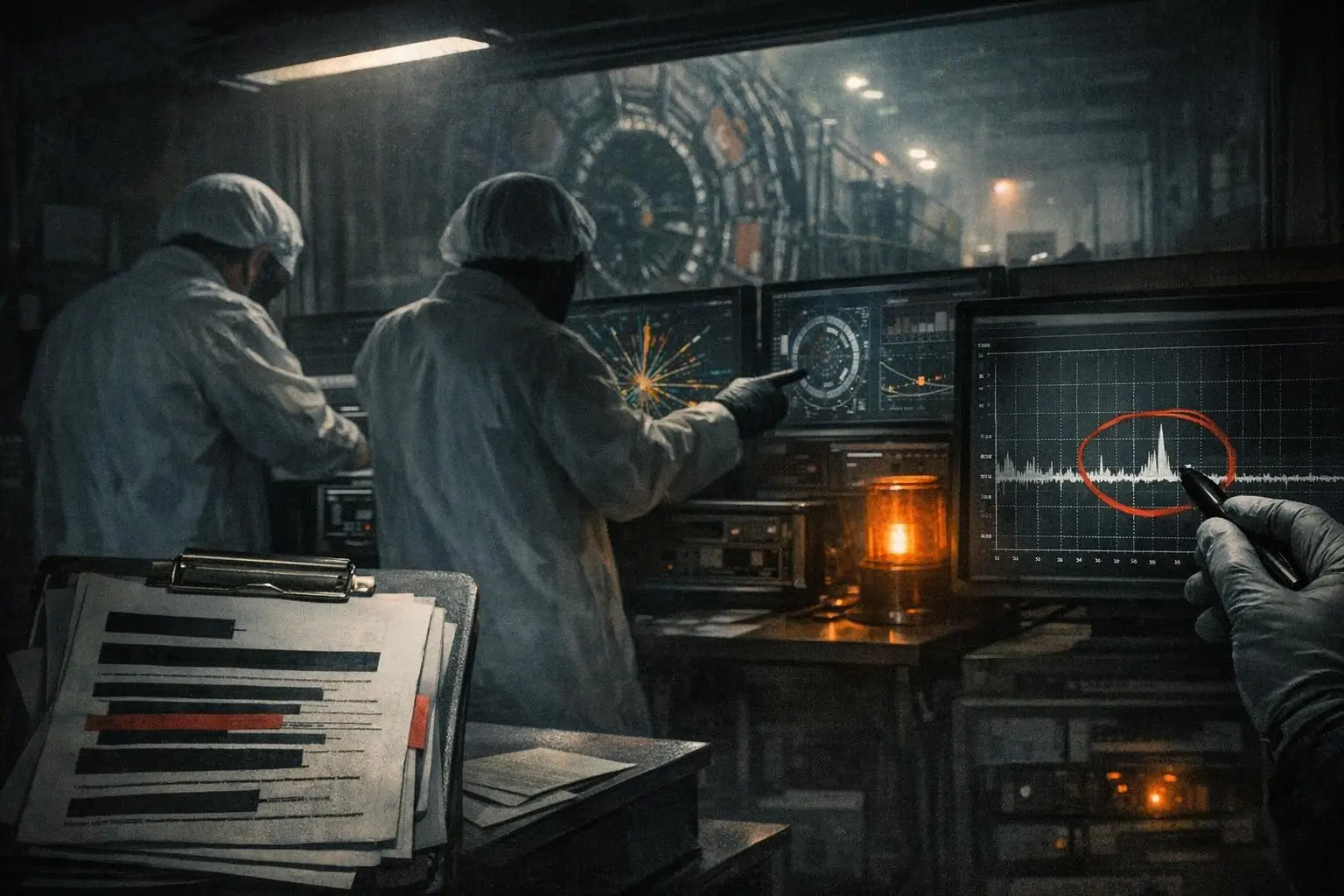
The described method is unsupervised machine learning applied to collision data, with the aim of flagging unusual events.
The flagged events are positioned as candidates for follow-up, placing them inside a workflow rather than a conclusion. The page does not convert a flagged outlier into a confirmed new phenomenon.
This administrative act is simple but decisive: it fixes how the experiment itself uses the word anomaly in public-facing material.
The page remains a briefing-level artifact in this slice, and the referenced peer-reviewed trail is not present alongside it.[1]
This document can certify terminology and process, but it cannot certify what any specific flagged event ultimately became. The next question is how non-confirmation is documented.
ATLAS briefing page: a 2015 excess that did not persist in 2016 data
ATLAS also preserves a concrete example of the gap between an apparent signal-like pattern and later stability: a reported excess in 2015 data that was not confirmed with 2016 data.
The record here supports one narrow point: an earlier data feature can look signal-like and still fail confirmation when more collisions are analyzed.
What this slice cannot do is generalize that outcome to other channels, other datasets, or other periods. It provides only this specific briefing example.[2]
The unresolved step, if the question concerns ‘inexplicable events’, is whether a given public claim is tied to a documented excess or only to the word anomaly used out of context.
CERN safety positioning: a press release and a bounded technical review artifact
CERN has issued an official press release stating that LHC operations have been reviewed for safety, including by independent scientists, in direct response to public safety concerns.
This slice also contains a separate, citable technical artifact: an arXiv PDF titled Review of the Safety of LHC Collisions.
What cannot be stabilized from this set is the wording of any canonical CERN Document Server safety report. No LSAG or LHC Safety Study Group report artifact is included here.
The next documentary question becomes specific: when safety concerns name a scenario, what does CERN choose to answer in its public FAQs, and how does it draw conceptual boundaries?[3]
CERN FAQ: black hole questions and a documented distinction
CERN’s public-facing FAQ materials explicitly address whether the LHC will generate a black hole.
In that context, CERN distinguishes hypothetical tiny ‘quantum’ black holes from astrophysical black holes, rather than treating the term black hole as a single object.

CERN explainer: extra dimensions framed through missing energy signatures
The record support ends at what the FAQ frames for the public. An FAQ is not an operational file and does not enumerate every analysis or review pathway.
The next question shifts from risk language to search language: when CERN discusses exotic hypotheses, what detector-facing signatures does it name rather than narrative claims about reality being torn?[4]
CERN explains that extra-dimension and graviton hypotheses at colliders are investigated through signatures such as missing energy, described as particles escaping detection.
This framing is a mechanism boundary in the record: the public materials describe what experiments look for in detectors, not a physical ‘dimension rip’.
What this explainer cannot certify, by itself, is any particular observation outcome from a given dataset. It functions as an explanatory guide rather than a result archive.
The next unresolved step is comparative: do other experiments describe searches for similarly high-attention ideas, like microscopic black holes, as routine analyses that yield constraints rather than incidents?[5]
CMS public summary: microscopic black hole searches as analysis, not incidents
CMS has publicly summarized dedicated searches for microscopic black hole signatures at the LHC as part of a standard analysis program.
Within this slice, the record supports the frame that these searches yield constraints rather than describe an operational incident.
The limit is that this is an institutional news summary. This archive slice does not attach a full analysis paper trail that would allow deeper method or dataset auditing.
The next question returns to terminology drift: when people label a collision narrative as ‘inexplicable’, are they describing a documented search program, or attaching meaning to the word anomaly that the experiments do not use?[6]
Run 3 framing and the query label problem: where ‘3I ATLAS anomalies’ fails to attach
CERN has also published a news item framing ATLAS work in the context of LHC Run 3 data. This functions here as a time-marker for modern search activity rather than a catalog of extraordinary events.
No validated source in this set supports ‘3I ATLAS anomalies’ as a recognized technical term, internal label, or documented incident category.
That absence matters because it blocks basic anchoring: without a stable term-to-document link, the archive cannot even choose which record series is being referenced.
The next documentary step is not interpretation but retrieval: identify what ‘3I’ is supposed to denote, and then locate the matching primary artifact in a controlled archive rather than in paraphrase.[7]
Where the record stops in this slice, and why it stops there
The opening question asks what can still be certified when a collision story is labeled an anomaly, and what can no longer be certified once the label detaches from documents.
This set can certify a limited pattern: ATLAS uses anomaly detection to mean unsupervised ML flagging of unusual events for follow-up, and ATLAS documents at least one apparent excess that did not persist with additional data.
This set can also certify that CERN has public safety statements and a public FAQ boundary for black holes, and that CERN frames extra-dimension ideas through signatures such as missing energy rather than through claims of a breach of reality.
Certification stops for concrete reasons inside this slice: the peer-reviewed paper referenced by the ATLAS anomaly-detection briefing is not present here, the canonical LSAG or LHC Safety Study Group report artifact is not present here, and the label ‘3I ATLAS anomalies’ does not resolve to a documented term in the validated sources.
Until those missing artifacts are retrieved and validated, the archive can describe workflows and public framing, but it cannot certify a list of ‘inexplicable events’ tied to specific collisions.[1]
FAQs (Decoded)
For additional case files in the paranormal records archive, consult the index. Related investigations include uap incident files and ufo sightings case files.
Sources Consulted
- ATLAS, briefing page Anomaly Detection. atlas.cern, accessed 2025-02-17
- ATLAS, briefing page High-mass di-photon resonances: first 2016 ATLAS results. atlas.cern, accessed 2025-02-10
- CERN, press release CERN reiterates safety of LHC on eve of first beam. home.cern, accessed 2025-02-03
- CERN, FAQ Will CERN generate a black hole. home.cern, accessed 2025-01-27
- CERN, explainer Extra dimensions, gravitons, and tiny black holes. home.cern, accessed 2025-01-20
- CMS, news item Search for microscopic black hole signatures at the Large Hadron Collider. cms.cern, accessed 2025-01-13
- CERN, news item ATLAS probes uncharted territory with LHC Run 3 data. home.cern, accessed 2025-01-06

A Living Archive
This project is never complete. History is a fluid signal, often distorted by those who record it. We are constantly updating these files as new information is declassified or discovered.