Poltergeist Activity: What the Records Show—and Where They Stop
What can this small academic record still certify about poltergeist activity, and what can it no longer certify about moving objects?
This file stays inside four linked artifacts and treats them as a limit-test for what can be said without case records.
- Peer-reviewed framing describes hauntings and poltergeist-like episodes as contagious reactions
- Parapsychology text treats living human agency as a possible hypothesis
- 1970s university context described for research into life after death, telepathy, psychokinesis
- No Tier 1 primary case records for headline poltergeist hauntings in this input set
- No documented investigation protocols or chain-of-custody practices in this input set
Those points mark the stable edge of certification available here, and the rest of the story is where the record stops.
The DOI landing page that preserves a single peer-reviewed framing sentence
A browser is pointed at a DOI address on journals.sagepub.com. The request resolves to a landing page rather than a local case file.
The page functions as a citation node. It is not, by itself, an investigative dossier on any reported disturbance.
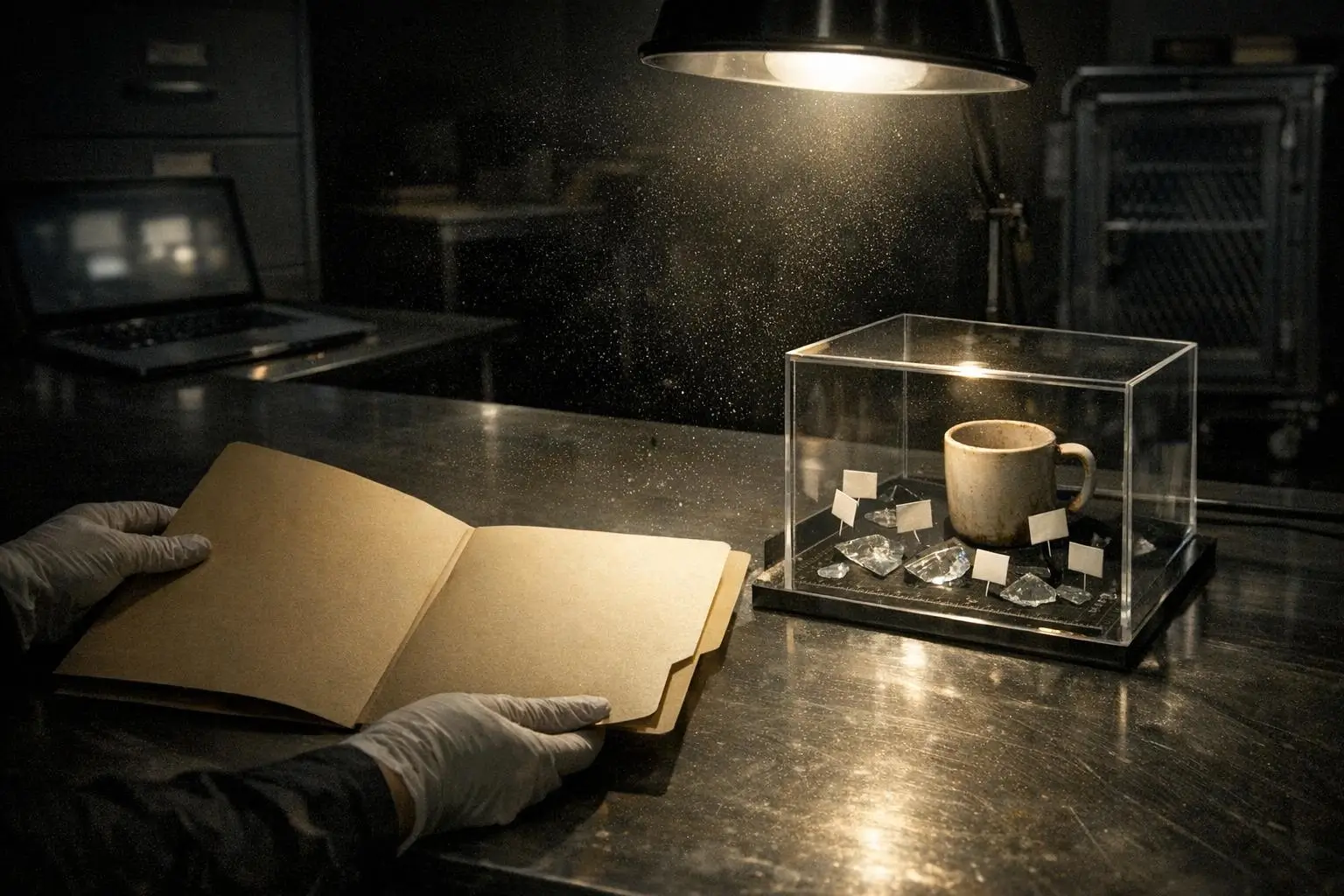
In this archive slice, the act is simple: locate the page and isolate only the wording explicitly carried forward. Nothing else on the page is treated as imported evidence.
No names of places, households, or investigators are stabilized through this object. The landing page does not supply police logs, engineering assessments, or formal witness statements.
The administrative outcome is a bounded reference point: a traceable location where a published framing can be pointed to without expanding beyond what is shown. It does not certify that any physical interaction occurred in any specific case.
What this can certify is a documented model sentence: hauntings and poltergeist-like episodes are argued to be products of contagious reactions to ambiguous environmental or cognitive events. It stops at the model rather than any case trail.[1]
A parapsychology PDF that names living human agency as a hypothesis
A separate PDF hosted by the University of Virginia Division of Perceptual Studies preserves a different kind of boundary statement.
Its certified sentence is narrow: it seems entirely reasonable to consider living human agency as a possible hypothesis to account for some genuine poltergeist phenomena.
The same line also constrains what can be claimed next. It frames living human agency as a possible hypothesis rather than a settled explanation.
Within this input set, that is as far as the statement goes. The record here does not attach that hypothesis to any named incident, site, or time-bounded sequence of moving objects.
The next unresolved question is procedural: if a case is claimed to involve physical interaction, what contemporaneous records would show how that claim was documented and handled?
A second university-hosted PDF that warns against turning associations into causes
Another University of Virginia Division of Perceptual Studies PDF is present in the source set. It is used here only as a constraint on language.
The permitted import from this artifact is structural rather than narrative. The brief preserves it as a summary of poltergeist agent characteristics alongside an emphasis on association versus causation.
That emphasis matters because it blocks a common slide in retellings. An association in case literature is not certified here as a mechanism, and it is not certified here as a cause.
The limit is direct: this source set still does not include the primary documentation where an association would be tested against controls, custody, or formal statements.
The next unresolved question is evidentiary, not thematic: where are the original notes, logs, or records that would let an outside reader check what was observed and when?
A UCLA Newsroom sentence that fixes a historical context, without certifying phenomena
A UCLA Newsroom feature contributes a single historical anchor that is easy to overuse if not kept in bounds.
The certified sentence is specific: in the 1970s, many universities gave space to serious people seeking scientific evidence of life after death, telepathy and psychokinesis.
That context can be carried forward as an institutional condition. It cannot be converted, inside this archive slice, into confirmation that entities produced unexplained physical phenomena.
The boundary is that the feature is not an investigation file for any poltergeist hauntings. It does not supply the contemporaneous materials that would allow a moving objects narrative to be audited.
The next unresolved question returns to documentation: what did those university-adjacent efforts preserve as records that could be checked today?
Where this archive slice breaks: missing case files and missing protocols
The friction in this file is not a fight between explanations. It is the absence of the materials needed to narrate any headline case as a documented sequence.
No Tier 1 primary records for named cases are present here. The input set does not include police incident reports, court filings, insurer records, engineering reports, or original investigative case files.
No methodological documents are present here either. The record does not stabilize controls, chain-of-custody handling for objects, or formal witness statement procedures.
Because those classes of documents are not in the provided sources, this article cannot certify poltergeist activity as an event-level claim about objects moving in a particular location. It can only certify how a few academic and institutional texts frame the discussion.
The open vector is documentary: identify and request contemporaneous police reports, local housing authority or council records, any court proceedings, and any original investigator archives held by institutions.
What can still be certified about poltergeist activity, and where certification stops
The record here can certify that two restrained framings exist side by side: a living human agency hypothesis in parapsychology writing, and a peer-reviewed model that describes episodes as contagious reactions to ambiguous events.
It can also certify a bounded institutional backdrop: a UCLA Newsroom feature states that, in the 1970s, many universities gave space to research-seeking work on life after death, telepathy, and psychokinesis.
What it cannot certify is the core thing most readers mean by poltergeist activity: a case-level chain of physical interactions where moving objects are documented under defined procedures.
Certification stops for concrete reasons in this slice: there are no contemporaneous case records, and there are no investigation-protocol documents that would show how observations were controlled and preserved.[2]
FAQs (Decoded)
Does this source set verify that an entity moved objects in a specific case?
No. The provided materials are framing and context items. They do not include primary case records that would certify event-level moving object claims. Source: University of Virginia Division of Perceptual Studies, university-hosted PDFs in this input set.
What does living human agency mean in this article?
It appears only as a possible hypothesis in a parapsychology text. The record here does not elevate it to a settled cause. Source: University of Virginia Division of Perceptual Studies, parapsychology PDF excerpt.
What is the peer-reviewed alternative framing included here?
One cited model describes hauntings and poltergeist-like episodes as contagious reactions to ambiguous environmental or cognitive events. This article keeps it at that wording level. Source: journals.sagepub.com, DOI landing page statement.
Does the 1970s university context act as proof that poltergeist activity is real?
No. In this record slice it functions only as historical context about universities giving space to certain research-seeking efforts, not as certification of phenomena. Source: UCLA Newsroom, magazine feature sentence.
Why are classic headline cases not retold here?
Because this input set does not include the contemporaneous records and protocols needed to separate documented events from later retellings within the article itself. Source: University of Virginia Division of Perceptual Studies, source-set scope constraints.
For additional context on related documentation approaches, consult the paranormal records archive, the ghosts and demons files, and real ghost sightings records.
Sources Consulted
- DOI landing page for a peer-reviewed article. journals.sagepub.com, accessed 2025-02-17
- UCLA Newsroom, magazine feature paragraph. newsroom.ucla.edu, accessed 2025-02-10

A Living Archive
This project is never complete. History is a fluid signal, often distorted by those who record it. We are constantly updating these files as new information is declassified or discovered.