Ancient Egypt Electricity: Between Soot Evidence and Silence
What can the surviving record certify about how ancient Egyptians lit tomb interiors, and what can it no longer certify about electricity?
This case sits between a documented lighting toolkit and a recurring modern claim about engineered light inside sealed spaces.
- Flame-based lighting attested in provided scholarship
- Oil lamps can provide steady practical illumination
- Fuel and wick design shape smoke and soot output
- Soot deposits documented on wall paintings in TT49
- Modern electric light bulbs framed as recent development
These points mark the stable edge of what this source set can certify, and everything else in this topic presses against that edge.
TT49 conservation documentation as an evidence gate: laser cleaning of soot-covered wall paintings
A web page on the Gerda Henkel Stiftung site records a conservation intervention focused on wall paintings in the Tomb of Neferhotep, labeled TT49.
The page treats soot as a material condition on the painted surface. It presents that condition as something requiring a specific response.
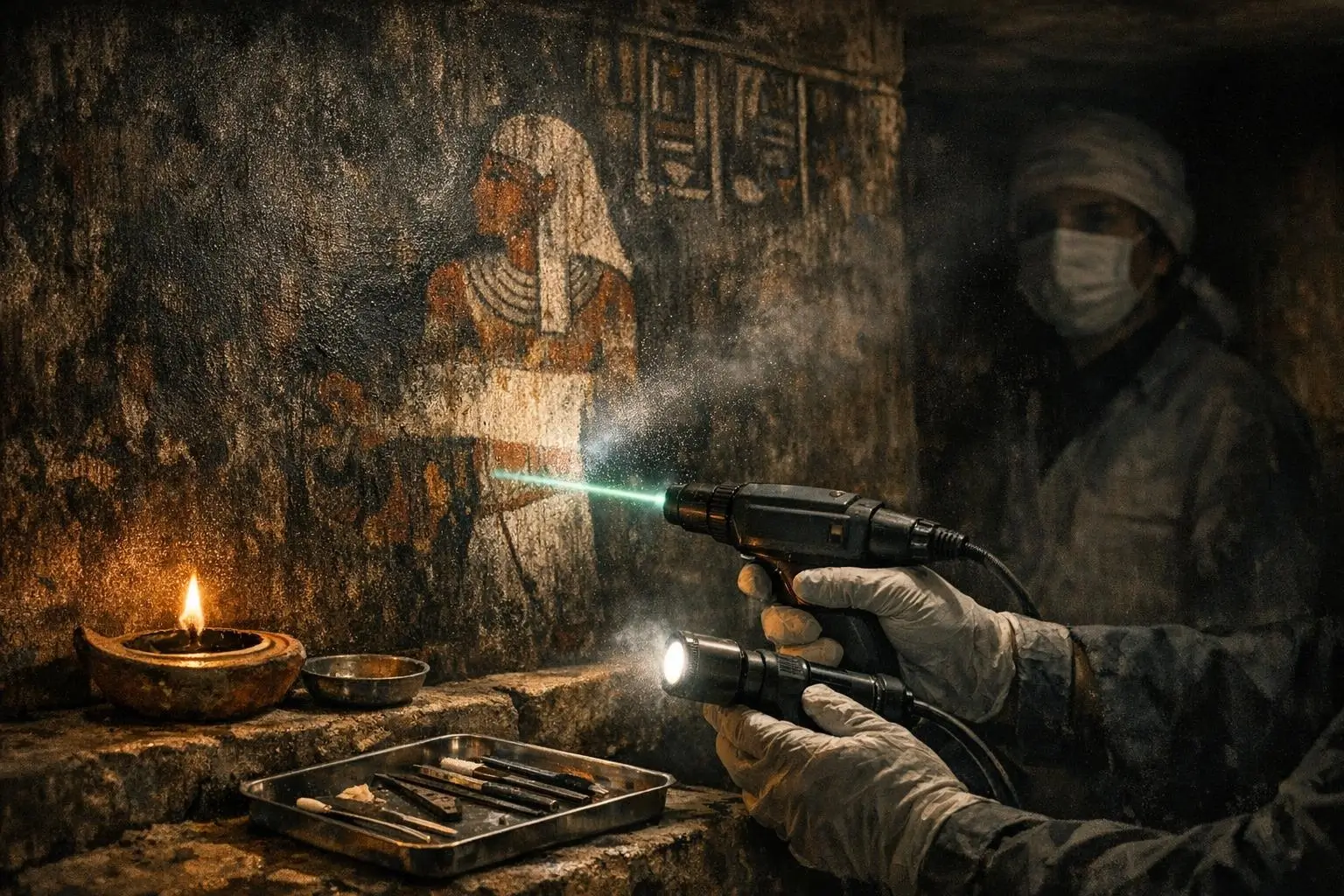
The intervention described is laser cleaning, named as the method used against soot deposits in that tomb context.
The page functions as an administrative record in one narrow way: it fixes a before-and-after problem statement around soot and cleaning. It does not expand into a comparative survey across tombs.
In this archive slice, the value is not a general claim about all Egyptian tombs. The value is that soot is documented as present, and documented as consequential enough to trigger cleaning work.
That is a concrete counterweight to any universal statement that tomb painting surfaces show no soot marks at all.[1]
This document can certify soot presence in at least one tomb context and a documented conservation response, but it cannot certify how common soot is across sites. That leaves the lighting baseline as the next question.
What the provided scholarship can certify about artificial light in ancient Egypt
Within this source set, the baseline record for artificial lighting in ancient Egypt is flame-based lighting, such as oil lamps and torches, rather than engineered electric lighting.
This matters because the central question often starts from ancient egypt electricity and reads tomb interiors backward from that idea.
Here, the record that is actually present does not start with electricity. It starts with attested flame sources as the documented toolkit.
The boundary is immediate: this set does not include site-by-site inventories for all tombs, and it does not include documentation that engineered electrical lighting was used as a standard practice.
That leaves a narrower next step inside the record: whether flame-based tools can meet practical constraints without leaning on absence-based arguments.[2][3]
Oil lamps as a practical tool, and why soot is not a one-variable test
The record in this set allows one practical point: oil lamps can provide steady light for use.
It also preserves a constraint that matters for tomb-illumination debates: lamp performance depends on fuel and wick design, and those choices influence smoke and soot output.
An experimental archaeology report is used here as a limiter, not as a substitute for Egyptological epigraphy. It keeps feasibility talk tied to observed burn behavior rather than dismissal.
The limit is that this archive slice does not certify the exact fuels, wick designs, or operating practices used in every ancient Egyptian context. It also does not certify a comparative soot outcome across multiple sites.
So the next unresolved question is not whether flame lighting is impossible in principle. The next question is what the multi-site conservation and archaeological record says when assembled side by side.[4]
The soot contradiction that breaks the universal claim
A popular argument around pyramid illumination and tomb workspaces is that the walls show no soot marks, so flames could not have been used.
Inside this source set, that universal premise does not hold steady because TT49 is documented as having soot deposits on wall paintings that required cleaning.

Anachronism control: what the record means by electric light bulb
This does not flip the argument into its opposite. One documented case cannot certify that soot is present everywhere, or that it accumulated the same way in every tomb or temple.
It does, however, force a tighter standard: soot cannot be treated as a simple absence-proof that pushes the record into electric lighting by default.
The unresolved next step remains missing in this archive slice: comparative, site-specific studies on soot presence and absence across multiple decorated spaces.[1]
Claims like dendera light bulb and electroluminescence egypt depend on naming an object before the record establishes it.
An institutional timeline framing in this set places the modern electric light bulb as a relatively recent technological development.
That framing does not, by itself, refute every imaginable earlier device. It does impose a requirement: if an ancient object is called a light bulb, the claim must be anchored in direct archaeological evidence strong enough to address the anachronism.
The boundary is clear in this archive slice: it does not include the material chain for engineered electrical lighting in ancient Egypt, and it does not include a peer-reviewed technical reconstruction tied to ancient finds.
So the next unresolved question is not what a relief resembles. The next question is what physical and documentary evidence can stabilize a device claim at all.[5]
Natural electricity in the record, and what it does not authorize
The provided record supports that ancient Egyptians were familiar with naturally occurring electrical phenomena through electric fish.
This is often treated as a bridge to engineered lighting. In this archive slice, that bridge is not certified.
The distinction that holds is categorical: awareness of a natural electrical effect is not evidence of engineered electrical technology used for illumination.
The boundary is that this set does not contain documentation connecting electric fish knowledge to a manufacturing tradition for electrical devices, and it does not contain device remains tied to tomb lighting.
That leaves the next question where the evidence actually has to live: in artifacts, technical chains, and primary documentation for specific alleged devices.[6]
The Dendera relief problem: the central image claim without primary epigraphy in this set
The strongest public-facing image claim in this topic is often attached to the Dendera crypt scenes and labeled the dendera light bulb.
In this archive slice, there is a hard stop: no Tier 1 primary epigraphic publications, plates, authoritative translations, or official mission documentation for those scenes are included.
Because of that absence, the record here cannot validate what the reliefs depict, what the associated texts say, or whether any proposed reading matches Egyptological publication standards.
This gap also blocks technical follow-on claims in a disciplined way. Without stabilized primary documentation, the archive cannot test proposals involving an arc lamp, a cathode tube, wiring, or any other engineered mechanism for illumination.
A related boundary is explicit in the constraints: a baghdad battery connection is not documented here, and cross-case linking is not allowed without an academically documented bridge inside the provided sources.
The next unresolved requirement is straightforward but unmet in this set: primary epigraphy for Dendera that can be checked, plus a documented technical feasibility chain that can be audited step by step.
Where certification stops on arc bulbs in tombs
The opening question asks whether Egyptians used arc bulbs inside tombs.
This archive slice can certify a narrower core: scholarship here supports flame-based lighting as the documented practice, and experimental work here supports that oil lamps can provide steady practical light with variables that shape smoke and soot.
It can also certify a specific contradiction to a common talking point: soot deposits are documented on wall paintings in TT49, and conservation cleaning is documented in that context.
Certification stops for three concrete reasons present in this set: primary epigraphic plates and authoritative translation for the Dendera crypt scenes are absent here, comparative multi-site soot studies are not present here, and no authoritative technical feasibility assessment is present here for an engineered electrical lighting chain in an ancient context.
Until those missing documentary objects enter the archive, the record can frame the limits of ancient egypt electricity claims, but it cannot lock an electric lighting mechanism to tomb practice.[2][3][1][4][5][6]
FAQs (Decoded)
Does this source set document electric lighting in ancient Egyptian tombs?
No. The provided scholarship anchors artificial lighting to flame-based sources such as oil lamps and torches, not engineered electric lighting. Source: JSTOR, academic book record on artificial light in ancient Egypt.
Do oil lamps produce usable light without heavy smoke?
This archive slice supports that oil lamps can provide steady practical illumination, and that smoke and soot output depends on fuel and wick design rather than a single factor. Source: EXARC, experimental archaeology article on kindling oil lamps.
Are there tomb paintings with soot deposits in the documented record here?
Yes, at least one tomb context is documented as having soot deposits on wall paintings that required conservation cleaning, namely TT49 in this set. Source: Gerda Henkel Stiftung, conservation project page on TT49 laser cleaning.
Does the Dendera light bulb claim get validated by the documents provided here?
No. This source set does not include Tier 1 primary epigraphic plates, authoritative translations, or official mission documentation for the Dendera crypt scenes, so depiction claims cannot be locked down here. Source: University of Cambridge Repository, thesis record used as a synthesis node for lighting evidence.
Does awareness of electric fish count as evidence of engineered electrical lighting?
No. The record here distinguishes natural electricity awareness, such as electric fish, from evidence of engineered electrical technology for lighting. Source: Oxford Academic, book chapter on the Nile electric catfish.
Why does the modern light bulb timeline matter for ancient claims?
It sets an anachronism control inside this archive slice: calling something a light bulb requires direct archaeological evidence strong enough to justify using a modern device label. Source: U.S. Department of Energy, explainer on the history of the light bulb.
This case connects to the hidden history archive where documentary standards shape what claims can survive review. The same evidentiary framework applies across the lost technologies case files that index disputed ancient mechanisms. Related documentation continues in the baghdad battery purpose files and the antikythera mechanism purpose records.
Sources Consulted
- Conservation project page on laser cleaning of wall paintings in the Tomb of Neferhotep (TT49). edit.gerda-henkel-stiftung.de, accessed 2025-02-17
- Academic book record on artificial light in ancient Egypt. jstor.org, accessed 2025-02-10
- Thesis record on artificial light in Pharaonic Egypt. repository.cam.ac.uk, accessed 2025-02-03
- Experimental archaeology article on kindling oil lamps. exarc.net, accessed 2025-01-27
- Explainer on the history of the light bulb. energy.gov, accessed 2025-01-20
- Book chapter on the Nile electric catfish. academic.oup.com, accessed 2025-01-13

A Living Archive
This project is never complete. History is a fluid signal, often distorted by those who record it. We are constantly updating these files as new information is declassified or discovered.