Columbus Discovery Cover-Up: What the Archives Can Certify
What can the surviving record certify about pre-Columbian arrivals in the Americas, and where does that certification stop?
This case file stays inside a small, validated archive slice, where a few documents set firm baselines and several popular claims float without support.
- UNESCO registry wording as the Norse baseline
- Earliest-evidence boundary for Europeans in North America stated at registry level
- PNAS test case title: Polynesian chickens to Chile
- Radiocarbon plus DNA used as a timing test in peer-reviewed work
- Zheng He voyages documented, but ‘1421 North America’ extension not carried here
These points mark the stable edge of certification in this specific source set, and nothing outside them is treated as settled.
Evidence gate: the UNESCO World Heritage Centre registry entry for L’Anse aux Meadows
A reader reaches the UNESCO World Heritage Centre page for L’Anse aux Meadows and stays inside the public registry description. The page presents a short, official-facing summary rather than a field report.
Within that summary, one sentence states that L’Anse aux Meadows ‘contains the excavated remains of a complete 11th-century Viking settlement’. The wording appears as a declarative registry line rather than a debated claim.
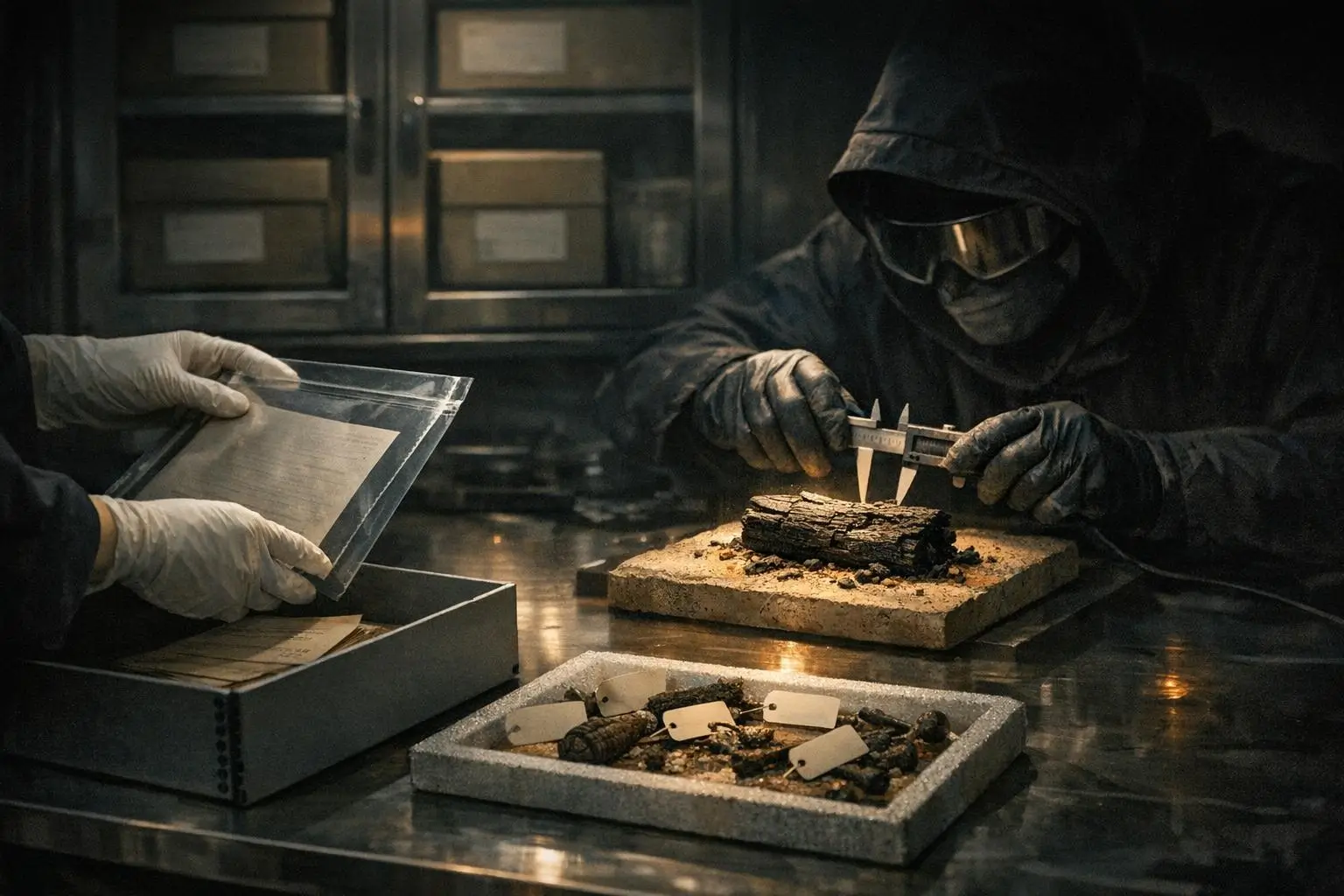
Elsewhere in the same registry framing, the site is described as ‘the earliest evidence of Europeans in North America’. The phrase is presented as a boundary marker for what the registry is willing to certify.
The visible text does not enumerate individual artifacts, excavation units, or laboratory protocols. It also does not provide a granular chain of dating steps that could be checked line by line.
The page functions as a public baseline because it stabilizes two phrases at institutional level. It does not, on its own, supply the underlying technical documentation that produced those phrases.[1]
From this entry, the record can certify UNESCO’s own baseline language for an 11th-century Norse settlement and an earliest-evidence boundary. It cannot certify excavation-level specifics from this archive slice, so the next question becomes which primary reports sit behind the registry summary.
Case file: a PNAS title that locks one pre-Columbian test to a single paper
One peer-reviewed anchor in this set is a PNAS article titled ‘Radiocarbon and DNA evidence for a pre-Columbian introduction of Polynesian chickens to Chile’. The title fixes the discussion to a bounded documentary object rather than a general story.
Within the constraints provided here, the certified point is methodological: peer-reviewed studies use radiocarbon dating and DNA analysis together to test whether a purported introduction occurred before European contact. This is a timing test, not a guarantee that any specific travel narrative is demonstrated.
This archive slice does not stabilize additional details about sampling, results, or dispute resolution for that paper. The next question is what the full article text, and later scholarly responses, would add or challenge when read in sequence.[2]
Dispute marker: an Oxford Biology summary that keeps sweet potato evidence unsettled
A separate institutional pointer in this set comes from a University of Oxford Biology news release focused on sweet potato research. Its function in this archive slice is not to settle contact, but to document that a widely cited indicator remains contested.
The certified boundary is procedural: sweet potato-style biological indicators remain under active scholarly debate, and newer research can challenge older contact readings. The record here preserves the existence of disagreement, not a final adjudication.
This slice does not include the full chain of papers on both sides of that debate. The next question is how competing datasets and methods are being weighed across peer-reviewed literature, and which claims survive replication.[3]

Plant proxies: what genetics and archaeobotany can reconstruct, and what they cannot certify alone
Several sources here show a repeated pattern: contact arguments are often built from proxies rather than direct voyage logs. In this slice, the certified tools are genetic and archaeobotanical analyses used to reconstruct origins and dispersal of domesticated plants.
A PMC-hosted peer-reviewed paper in this set addresses an Asian origin for a domesticated plant in the Americas. The stable point is the analytical approach, because reconstruction work can complicate a simple narrative that maps plant presence directly onto one human voyage claim.
A second peer-reviewed anchor addresses Polynesian bottle gourd dispersal. Its presence in this set blocks single-indicator certainty by showing that even genetic proxy debates can remain active rather than closed.
An Antiquity article page titled ‘Plant Evidence for Contacts with America before Columbus’ adds an explicit evidentiary frame at journal level. This slice does not allow a jump from plant dispersal pathways to a certified claim of deliberate exploration, so the next question is what combination of archaeology, dating context, and peer-reviewed synthesis can narrow the gap.[4][5][6]
Chronology boundary: what the Zheng He overview certifies, and what it does not carry
The validated material for Ming maritime activity in this slice is an educational overview hosted by the Association for Asian Studies. It certifies a bounded chronology without extending into modern discovery headlines.
Within that overview, the record supports that China’s Ming dynasty launched seven voyages led by Admiral Zheng He, and that these voyages were known then to the Chinese as the ‘West Oceans’. That is the anchored core available here.
A separate claim often attached in surrounding discourse is that a 1421 fleet ‘would ultimately discover the North American continent’. This archive slice does not preserve documentation that makes that North America extension stable, so it remains unverified within this set.
The next question is documentary, not rhetorical: which primary Ming records, translations, or peer-reviewed historiography are being used to argue specific destinations, and are those materials present and citable at Tier 1 level.[7]
What a ‘cover-up’ frame would require, and what this archive slice does not contain
The search language around this topic often uses the word cover-up. In this validated set, there are no Tier 1 institutional records that describe suppression, concealment, or an official response to a specific alternative-arrival thesis.
The same limit appears with Phoenician crossing variants. No validated Tier 1 or Tier 2 documentary anchors for alleged Phoenician crossings are included here, so feasibility narratives cannot be treated as occurrence within this slice.
This absence does not certify that nothing happened. It only certifies that, here, the record cannot be used to name motives, institutional behavior, or a settled list of pre-Columbian arrivals beyond the bounded baselines already cited.
The next question is practical: which primary excavation documentation, and which peer-reviewed evaluations of high-visibility claims like ‘1421’, can be added to move from discourse to certifiable record.
Where the record can certify pre-Columbian contact, and where it stops in this file
The opening question asks what can still be certified, and what cannot. In this archive slice, the clearest certified baseline is UNESCO’s registry language for L’Anse aux Meadows as an 11th-century Viking settlement and as an earliest-evidence marker for Europeans in North America.
This slice also certifies a method pattern rather than a single sweeping conclusion. A PNAS case file title fixes one test case, and the documented approach uses radiocarbon plus DNA to evaluate pre-European-contact timing claims.
It also preserves two kinds of limits. Some proxies, like sweet potato-style indicators, are explicitly documented here as disputed, and plant genetics or archaeobotany can complicate simple voyage narratives without certifying deliberate exploration on their own.
Certification stops for concrete reasons inside this file: there is no primary excavation documentation for L’Anse aux Meadows included here, there is no Tier 1 evaluation of the ‘1421 North America’ thesis in this set, and there are no validated sources for Phoenician crossings in this slice.[1][2][3][7][5]
FAQs (Decoded)
For more case files where documentary limits shape what can be certified, explore the hidden history archive. Related historical record dispute files track similar verification boundaries. The vatican archive access files examine institutional documentation constraints, and the alexandria loss records file indexes a case centered on surviving record limits.
Sources Consulted
- World Heritage List entry for L’Anse aux Meadows. whc.unesco.org, accessed 2025-02-07
- DOI landing page for the article titled ‘Radiocarbon and DNA evidence for a pre-Columbian introduction of Polynesian chickens to Chile’. pnas.org, accessed 2025-01-31
- News release page on sweet potato research challenging early contact between America and Polynesia. biology.ox.ac.uk, accessed 2025-01-24
- Full-text peer-reviewed paper hosted on PMC. pmc.ncbi.nlm.nih.gov, accessed 2025-01-17
- Antiquity article page titled ‘Plant Evidence for Contacts with America before Columbus’. cambridge.org, accessed 2025-01-10
- Molecular Biology and Evolution article page on Polynesian bottle gourd dispersal. academic.oup.com, accessed 2025-01-03
- Educational overview page on Admiral Zheng He voyages to the ‘West Oceans’. asianstudies.org, accessed 2024-12-27
A Living Archive
This project is never complete. History is a fluid signal, often distorted by those who record it. We are constantly updating these files as new information is declassified or discovered.