Ancient Egyptian Secrets: What the Data Shows—and Where It Stops
What can the surviving record still certify about measurement signals at Giza, and where does it stop before architecture becomes assertion?
This file stays with instruments, published summaries, and one documented inspection step, and it marks where each claim loses certification.
- Muography as density-contrast imaging via cosmic-ray muon attenuation
- Corridor-like void near Khufu’s north face reported in ScanPyramids-related documentation
- Endoscope or camera inserted through a stone joint at north-face chevrons to visually inspect a void
- GPR and ERT used at Giza-area sites to detect subsurface anomalies by contrast
- Menkaure investigation reports two air-filled voids with explicit caution on interpretation
These points define the stable edge of what the provided materials can certify, without adding function, motive, or unrecorded outcomes.
IAEA News Center explainer on muon imaging, the boundary document for what muography can claim
An IAEA News Center explainer describes how muon imaging looks inside large objects.
It frames the method as counting cosmic-ray muons after they pass through a target. It ties image contrast to attenuation differences between denser material and lower-density space.
The piece describes a setup in which detectors register muons along multiple paths so an internal density structure can be reconstructed from measured flux.
It keeps the output at the level of density variation rather than room labels. It does not treat a detected contrast as a confirmed chamber with a defined function.
In that framing, a void is not an excavated space in the archaeological sense, but a region where the muon signal is consistent with lower attenuation than surrounding stone.
By issuing this explainer as an institutional reference, the IAEA fixes a core limit for later pyramid claims: muography is a density-contrast measurement, and nothing more is certified by the method alone.[1]
This document can certify what muography measures and what it cannot label, but it does not answer which specific contrasts at Giza have been verified beyond measurement signals.
The ScIDEP muon radiography project paper, a peer-reviewed anchor for ScanPyramids-era measurement work
A peer-reviewed paper in the Journal of Applied Physics documents the ScIDEP muon radiography project at the Great Pyramid and places muon imaging in a formal research context.
It anchors muography to detectors, measurement geometry, and reconstruction practice, a different documentary class than a headline summary.
The article reads like an instrumentation and methods record, which helps constrain language to what muon data can support in principle.
Even with a peer-reviewed touchpoint, the provided record does not stabilize a complete geometry and uncertainty set for every void-related claim circulating in popular summaries.[2]
The north-face chevrons camera inspection, the narrow point where an internal void is visually checked
A public report describes a corridor-like void near the Great Pyramid’s north face in ScanPyramids-related reporting.
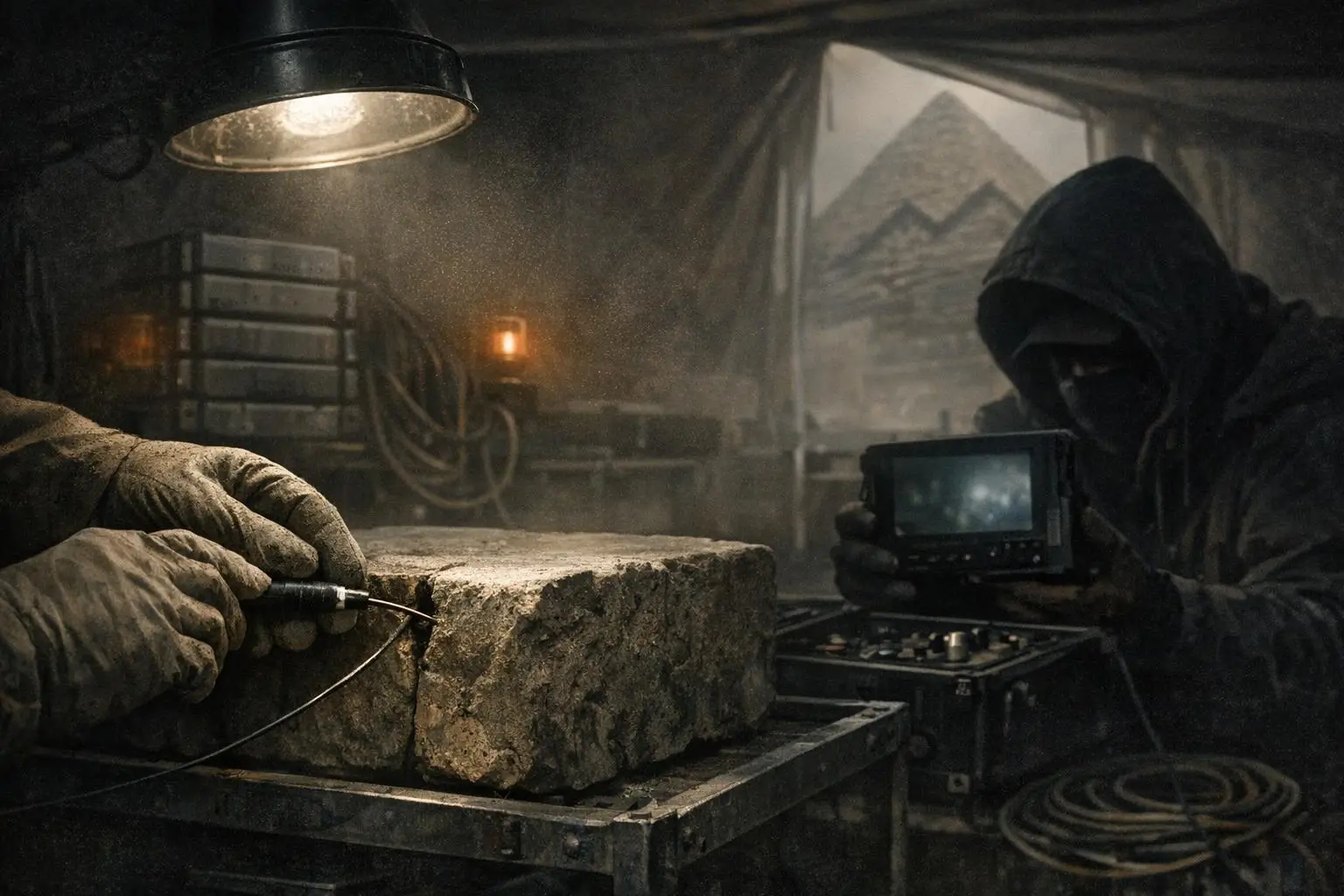
It also documents a direct inspection step: an endoscope or camera inserted through a joint between stones at the north-face chevrons to look into the space.
That inspection supports a basic certification that the signal corresponds to a real void, not only to an indirect contrast in a reconstruction.
The same record set does not certify what the void is for, whether it connects to other internal spaces, or how it fits into a full architectural plan.
The next unresolved document target is not another description, but a technical follow-up record carrying uncertainty bounds, geometry, and on-site authorization context not present here.[3]
A Giza-area GPR and ERT study, what subsurface instruments can and cannot turn into structure
A peer-reviewed write-up in Archaeological Prospection documents ground-penetrating radar and electrical resistivity tomography use in a Giza-area context.
Within the provided record, GPR is presented as contrast-based subsurface sensing through electromagnetic or radiowave response differences, and ERT as contrast-based sensing through electrical resistivity differences.

A Giza-area GPR and ERT study, what subsurface instruments can and cannot turn into structure
Those tools can flag anomalies relative to surrounding material, but an anomaly is not automatically a chamber, corridor, or entrance in the archaeological meaning of those words.
In this source set, the decisive bounding layer for subsurface claims at Giza is missing: primary permits, official technical reports, or site bulletins that would clarify what was authorized, tested, and verified on the ground.[4]
The Menkaure Pyramid press-release detection, two voids reported with a built-in caution
A Technical University of Munich press release reports an investigation of the Menkaure Pyramid that detected two air-filled voids using a combination of radar, ultrasound, and ERT.
The same statement cautions that such voids could indicate a potential entrance, but that the detection does not by itself confirm an entrance or establish the function of the spaces.
The press release reads like an early disclosure rather than a full methods and results package, and the provided materials do not include a peer-reviewed paper or released datasets for the Menkaure detections.
What remains unresolved is the technical layer that would normally constrain uncertainty, alternative interpretations, and measurement parameters beyond the institutional summary.[5]
Underground at Giza is also known archaeology, a landscape context that changes what an anomaly can mean
A Harvard-hosted academic text in the provided set treats Giza as a wider archaeological landscape that includes many mastaba tombs and associated underground components.
That context matters because the phrase underground structures can point to known funerary architecture as well as features not yet mapped in public reporting.
A Smithsonian Magazine report in the same source set describes unmarked underground structures found alongside the Great Pyramid, but this record alone does not certify how those structures relate to specific instrument anomalies or to pyramid interiors.
The next unresolved step is documentary linkage: site plans, technical reports, or permit documentation that ties a specific anomaly to a specific verified feature in the ground.[6][7]
Popular summaries and the geometry gap, where language outpaces the uncertainty carried in this file
A Science News summary in the provided set discusses muon-based imaging and void reporting at the Great Pyramid for a general audience.
Within this record, popular summaries often do not carry the quantified uncertainty and full geometry needed to state exact shapes, dimensions, or engineering implications without drift.
This is where the most common contradiction forms in the archive: instrument-limited outputs are translated into chamber-like language while measurement bounds and verification steps are not always carried along.
What remains unresolved is simple to name but hard to obtain from this file alone: peer-reviewed figures, tables, and supporting datasets that stabilize geometry and uncertainty for each reported void.[8]
Where the record stops under the sands of Giza
The record can certify that multiple tools are being used to look for contrast at Giza: muography for density, and geophysical methods for subsurface response and resistivity differences.
It can also certify one narrow point of direct checking: a camera or endoscope inspection through a stone joint at the north-face chevrons that supports the presence of a real void.
It can certify that Menkaure reporting, at least at press-release level, describes two air-filled voids detected by radar, ultrasound, and ERT, with explicit caution that this does not confirm an entrance.
Certification stops where the file lacks primary bounding documents: Egyptian permit or excavation records, peer-reviewed Menkaure methods and results, released datasets, and consistent uncertainty and geometry in public summaries.[1]
FAQs (Decoded)
Does muography prove the presence of a chamber?
No. In this record, muography is defined as density-contrast imaging from cosmic-ray muon attenuation, which can indicate contrast but does not certify function or labels. Source: IAEA, News Center explainer.
What is the strongest direct confirmation mentioned here?
The provided materials describe a camera or endoscope inspection through a joint at the north-face chevrons, which supports that a void exists beyond indirect signals. Source: Archaeology Magazine, news report on corridor-like void inspection.
Do the Menkaure voids confirm a new entrance?
No. The press-release wording in this record is cautious and treats the voids as a detection that could indicate a potential entrance, without confirming one. Source: Technical University of Munich, press release on air-filled anomalies.
Why are GPR and ERT results not the same as mapped underground rooms?
In this record, GPR and ERT are described as contrast-based methods that detect anomalies in response or resistivity, which need follow-up verification before being treated as specific structures. Source: Wiley, Archaeological Prospection methods write-up.
Why can underground reports near Giza be hard to interpret from summaries alone?
Because the Giza landscape includes many mastaba tombs and underground components, and the provided record does not consistently tie each reported anomaly to a verified feature with full plans and uncertainty bounds. Source: Harvard University, DASH-hosted academic text.
For more instrument-based records and site-linked documentation, explore the hidden history archive. Related files in the ancient civilizations files carry similar certification limits. See also the atlantis site claim files and lemuria continent records for comparative indexing of ancient geography claims.
Sources Consulted
- IAEA, News Center explainer on muon imaging. iaea.org, accessed 2025-02-07
- AIP Publishing, Journal of Applied Physics article on the ScIDEP muon radiography project. pubs.aip.org, accessed 2025-01-31
- Archaeology Magazine, news report on a newly revealed corridor-like void at the Great Pyramid. archaeology.org, accessed 2025-01-24
- Wiley, Archaeological Prospection article describing GPR and ERT work in a Giza-area cemetery context. onlinelibrary.wiley.com, accessed 2025-01-17
- Technical University of Munich, press release on detection of air-filled anomalies in the Menkaure Pyramid with cautionary framing. tum.de, accessed 2025-01-10
- Harvard University, DASH-hosted academic text on Giza landscape context. dash.harvard.edu, accessed 2025-01-03
- Smithsonian Magazine, report on unmarked underground structures alongside the Great Pyramid. smithsonianmag.com, accessed 2024-12-27
- Science News, popular summary on muon particle imaging and void reporting at the Great Pyramid. sciencenews.org, accessed 2024-12-20
A Living Archive
This project is never complete. History is a fluid signal, often distorted by those who record it. We are constantly updating these files as new information is declassified or discovered.