Suppressed Inventions: From Patent Secrecy to Unresolved Gaps
What can the record still certify about patent secrecy orders, and what can it no longer certify about suppressed inventions that allegedly disappeared?
This file separates a documented secrecy mechanism from the popular category of inventions that disappeared, using only the surviving record in this source set.
- Secrecy orders exist for some US patent applications
- FAS curates an Invention Secrecy document hub
- Legal scholarship outlines secrecy-order categories and procedures
- FCC Part 15 sets operating conditions for many RF devices without an individual license
- CRUK and FDA reject cancer-cure marketing claims around certain devices and products
These points mark the stable edge of certification in the current archive slice, and nothing beyond them can be treated as settled here.
The FAS publication page that states the secrecy-order trigger and restriction
A patent application exists in a state where disclosure would normally follow the filing path, but the record preserves a conditional interruption.
On the FAS publication page, the trigger is framed as a judgment that disclosure would be detrimental to national security. That judgment is treated as the decision point.
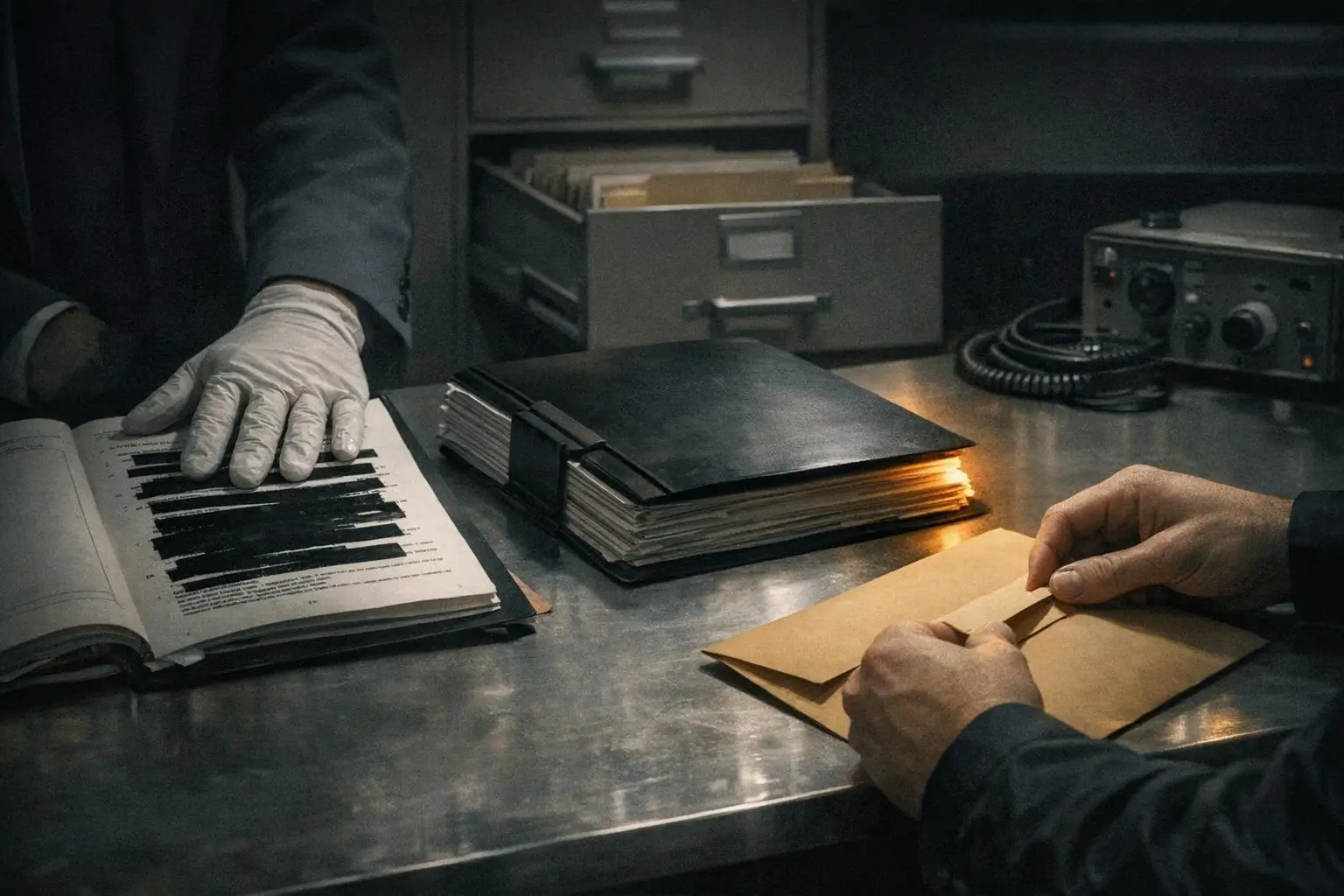
Once that condition is met, the page describes an administrative act: a secrecy order may be imposed on the patent, and the invention is not handled as ordinary public material.
The same description ties the order to restrictions on publication and disclosure. It treats those restrictions as the core function of the order.
The page also situates the act inside a broader secrecy-order framework, but it does not place any specific named invention inside the frame.
What remains on the page is the trigger language and the restriction outcome, preserved as a public description of how the order is supposed to work.[1]
This artifact can certify that a national-security criterion and a disclosure restriction are part of the described secrecy-order system, but it does not identify which applications were covered or why. The next question is where the underlying official record sits.
The FAS Invention Secrecy collection as a bounded entry point, not a case file
The FAS Invention Secrecy collection is presented as a curated hub for secrecy-order and Invention Secrecy Act framework materials.
In this source set, that curation can be used as an entry point to the system itself, including the claim that the framework requires the government to impose secrecy orders on certain patent applications containing sensitive information.
The boundary is immediate: this hub does not, in the materials preserved here, supply Tier 1 documents that connect secrecy orders to popular categories like water powered cars, cloudbusters, patents hidden, or other inventions that disappeared.
The next unresolved step is to locate primary, official artifacts that would allow application-level linkage, if such linkage exists.[2]
What legal scholarship can describe about secrecy-order procedures, and where it stops
A legal scholarship source in the Texas A&M Journal of Property Law explicitly frames its purpose as discussing different types of secrecy orders and the procedures by which the Government can place them on patent applications.
That is enough to certify that the record includes an articulated typology-and-procedure layer beyond the brief trigger language. This layer is treated as a describable process rather than a single event.
The limit is that this archive slice does not preserve, in extracted form, a stable list of the types or a step-by-step procedural sequence that can be quoted without overreach.
The next question is what the missing Tier 1 statutory text would confirm or constrain about those procedures.[3]
The gaps that block trend claims and statute-level quotation in this source set
The brief flags that the Tier 1 statutory text for the Invention Secrecy Act of 1951 is not included here. Direct quotation of the codified law cannot be stabilized from this archive slice.
The brief also flags that official annual secrecy-order reporting is not included. Counts and trend lines cannot be attributed to USPTO reporting within this file.
These absences matter because they are the missing objects that would normally anchor exact legal language and official usage levels.
The next unresolved step is retrieval of the Public Law or codified text and the relevant USPTO reporting artifacts as primary anchors.[2]

When an extraordinary device claim meets ordinary RF rules: 47 CFR Part 15
The eCFR text for 47 CFR Part 15 states that the part sets out regulations under which an intentional, unintentional, or incidental radiator may be operated without an individual license.
That baseline can certify that at least some radio-frequency device operation is framed through compliance conditions, not through a secrecy mechanism.
The boundary is that Part 15, as preserved here, does not certify anything about a specific claimed suppressed invention. It does not adjudicate whether a device works as advertised.
The next question is where a claim crosses from emissions compliance into separate domains like health claims or patent-disclosure restrictions.[4]
Rife machines in the record: RF output described, cancer cure rejected
Cancer Research UK states that the Rife machine produces low energy waves, also called radio frequency electromagnetic fields.
The same page states that they cannot cure cancer. This fixes a clear institutional position against the core therapeutic claim often attached to the device category.
The US FDA separately frames products claiming to cure cancer as a cruel deception. This documents an enforcement and consumer-protection posture toward cure marketing claims.
The limit is strict in this file: these sources certify institutional rejection of cancer-cure claims, but they do not certify why any particular device story became framed as suppression rather than non-efficacy or enforcement.
The next question is what primary enforcement records, if any, would be needed before any disappearance or suppression narrative could be tested against documents.[5]
A documented narrative pattern: suppression claims inside complementary and alternative medicine
A peer-reviewed commentary notes that proponents of complementary and alternative medicine often claim their treatments are victims of a well-coordinated attack by an establishment, including references to big pharma.
That statement can certify the existence of a recurring narrative pattern that appears in disputes over efficacy and legitimacy.
The boundary is that this pattern reference does not assign motive to any institution and does not certify that any specific invention was suppressed.
The next question is whether a given story has independent, Tier 1 documentation that can separate a pattern claim from a documented administrative act.[6]
Cold fusion as a documented example of rapid testing without a suppression finding
UC Berkeley’s Understanding Science case study states that within about a year of the 1989 cold fusion claims, the scientific community investigated and came to a consensus that what had been observed was not really cold fusion.
That record can certify a procedural outcome pattern: an extraordinary claim can be met with rapid investigation and a stabilization of consensus against the claimed effect.
The limit is that this case study does not speak to patent secrecy orders. It does not certify anything about popular categories like inventions that disappeared.
The next question is whether a given suppressed-inventions story has comparable documentation of testing, review, and a stabilized outcome, rather than only repetition.[7]
Closure: what can be certified about suppressed inventions, and why the record stops
The opening question asked what the record can still certify about secrecy restrictions, versus what it can no longer certify about suppressed inventions.
This source set can certify that a secrecy-order mechanism exists in the patent-application context, including a stated trigger tied to national security and a restriction on publication or disclosure.
It can also certify that ordinary RF devices sit inside an emissions compliance framework, and that institutional medical sources reject cancer-cure claims for Rife machines and similar marketing.
Certification stops because the Tier 1 statutory text is not present here, official annual secrecy-order reporting is not present here, and primary documentation tying secrecy orders to popular disappeared-invention cases is not present here.
The remaining work is retrieval: statute text, official reporting artifacts, and case-level records that would allow any linkage claim to be tested rather than repeated.[1]
FAQs (Decoded)
Does this record certify that suppressed inventions are real?
No. This archive slice certifies a secrecy-order mechanism and several regulatory and institutional positions, but it does not certify that specific inventions disappeared due to suppression. Source: Federation of American Scientists, Invention Secrecy materials.
What is the documented condition for imposing a secrecy order on a patent application?
The preserved description frames the trigger as a judgment that disclosure of a new invention would be detrimental to national security. Source: Federation of American Scientists, publication describing secrecy orders.
Does this file show which inventions received secrecy orders?
No. The sources here describe the framework and procedures at a high level, but they do not provide application-level identification or a case list. Source: Federation of American Scientists, Invention Secrecy collection.
Are Rife machines documented as curing cancer in these sources?
No. Cancer Research UK states that Rife machines produce low-energy radio-frequency electromagnetic fields and that they cannot cure cancer. Source: Cancer Research UK, Rife machine and cancer page.
Is RF regulation evidence that a device is being suppressed?
No. The Part 15 text documents conditions for operating certain radiators without an individual license, but it does not certify suppression or device performance. Source: eCFR, 47 CFR Part 15 text.
Why does the article keep returning to missing documents?
Because this archive slice lacks the Tier 1 statutory text and official annual secrecy-order reporting, and it lacks primary case records for popular disappeared-invention claims, the record cannot close those questions. Source: Federation of American Scientists, Invention Secrecy materials.
For additional context on documentation gaps and institutional secrecy frameworks, consult the classified science archive. Related files on disclosure restrictions and device-claim verification appear in the suppressed technology records. Adjacent case studies include tesla records and files and free energy device files.
Sources Consulted
- FAS publication describing secrecy orders. fas.org, accessed 2025-02-17
- FAS Invention Secrecy collection page. sgp.fas.org, accessed 2025-02-10
- Texas A&M Journal of Property Law scholarship on secrecy-order system. scholarship.law.tamu.edu, accessed 2025-02-03
- eCFR 47 CFR Part 15 text. ecfr.gov, accessed 2025-01-27
- Cancer Research UK Rife machine and cancer page. cancerresearchuk.org, accessed 2025-01-20
- Peer-reviewed commentary on CAM suppression narratives. pmc.ncbi.nlm.nih.gov, accessed 2025-01-13
- UC Berkeley Understanding Science cold fusion case study. undsci.berkeley.edu, accessed 2025-01-06
A Living Archive
This project is never complete. History is a fluid signal, often distorted by those who record it. We are constantly updating these files as new information is declassified or discovered.