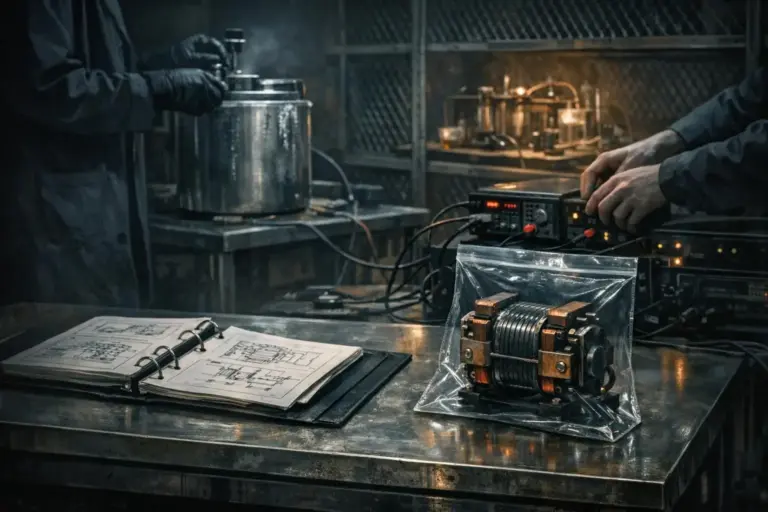
Antigravity: Between Silent Propulsion and Official Records
What can still be certified about silent, high-voltage thrust and institutional antigravity paperwork, and what can the record no longer certify?
This case file holds a few hard anchors in public institutional records, plus several gaps that resist being closed with the sources provided.
- MIT documented no-moving-parts flight using ionic-wind thrust
- AIAA literature frames Biefeld–Brown thrust-in-air as EHD or corona wind, not gravity change
- NASA-hosted report discusses a reported YBCO gravity-shielding claim without validating it
- NAVAIR FOIA release includes a document titled ‘Inertial Mass Reduction Device’ (PAX 205)
- Smithsonian cautions WWII ‘wonder weapon’ narratives often inflate beyond evidence
These points define the stable edge of certification in this brief, and the remainder stops where documentation and replication are not preserved here.
The NAVAIR FOIA PDF titled ‘INERTIAL MASS REDUCTION DEVICE’ (Navy Case PAX 205)
A Navy FOIA web path leads to a PDF labeled as a final version file for a request identifier visible in the filename. The artifact is presented as a downloadable document rather than a summary page.
The PDF’s title line is preserved as ‘INERTIAL MASS REDUCTION DEVICE’. The same file naming string also carries the internal tag ‘PAX 205’.
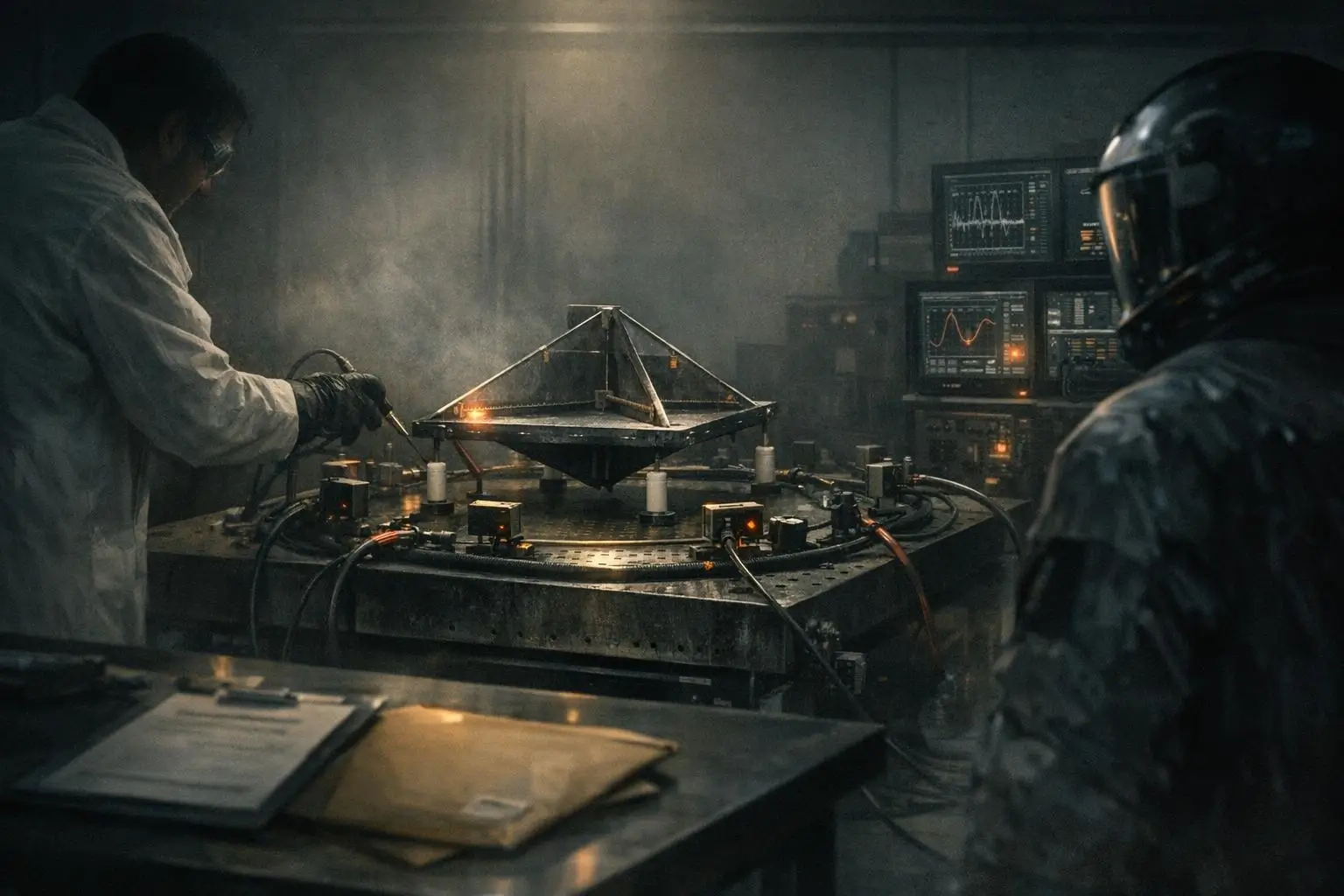
The administrative act observable here is the public release itself. The record supports that a document with this title exists in a NAVAIR FOIA release channel.
The release, by its form, does not certify that any device described inside the PDF was built. It also does not certify that any described effect was measured as successful.
What the file does certify is narrower. It certifies that a concept under this name entered a document stream later releasable under FOIA processes.[1]
This artifact stabilizes existence and wording, but it does not stabilize performance, test conditions, or replication. That pushes the next question back onto demonstrated propulsion records.
MIT’s public record of no-moving-parts powered flight
MIT publicly documented powered flight of an aircraft with no moving parts. The record frames the thrust as ionic wind, also described as electrohydrodynamic thrust in air.
This fixes a real ‘silent propulsion’ artifact in the open record. It does not fix any claim of gravity cancellation, because the mechanism described remains atmospheric propulsion by ions in an electric field.
The unresolved next step is not whether the flight occurred, but how often similar demonstrations are later narrated as ‘antigravity’ despite a mechanism that stays inside the air.[2]
What electrohydrodynamic thrust in air does, and what it cannot certify
Electrohydrodynamic propulsion produces thrust in air by accelerating ions in an electric field. In this brief, it is treated as a candidate for very quiet propulsion, because it does not require conventional moving parts to generate thrust.
The boundary is explicit in the provided record. A propulsion mechanism in air is not evidence of gravity cancellation, and the archive slice here does not contain a validated transition from EHD thrust to antigravity claims.
The unresolved question is procedural: when an observer sees thrust near high voltage, what documentation is needed to keep the explanation tied to air-ion dynamics instead of drifting into gravity-control language.[3]
The AIAA mechanism boundary on the Biefeld–Brown effect in air
A peer-reviewed aerospace source in the provided set argues that thrust attributed to the Biefeld–Brown effect in air is best explained as electrohydrodynamic phenomena, commonly framed as corona or ion wind. In that framing, asymmetric-capacitor thrust-in-air is not treated as a modification of gravity.
This matters because it pins a popular electrogravitics narrative to a documented disagreement with the literature. The record here supports the EHD interpretation in air, and it does not preserve a certified route from these observations to gravity modification.
The next unresolved question concerns environment and controls, but this brief does not include a dataset that would let the archive certify a gravity effect under different conditions.[4]

The NASA-hosted report on a reported Type II superconductor gravity effect
NASA hosted a technical document discussing reported claims of a gravity-shielding effect above a rotating YBCO superconductor. The certified point is institutional awareness and technical discussion, not validation.
The boundary is carried by what is missing in this brief. Primary experimental datasets, apparatus detail sufficient for reproduction, calibration procedures, and independent peer-reviewed replications are not present here. The effect cannot be treated as demonstrated inside this archive slice.[5]
The unresolved next step is concrete: locate original measurement logs and independent replication datasets matching the level of detail needed to stabilize a claim.
The arXiv preprint as a record of ongoing claims, not a settled result
An arXiv PDF appears in the validated set as a record of ongoing claims or attempts related to the same gravity-effect topic area. Within the constraints of this brief, it is not treated as peer-reviewed consensus validation.
This creates a documentary tension that does not resolve itself. The archive can preserve that activity continues in some form, but it cannot certify that the underlying effect is established without independent peer-reviewed replication and fully documented measurement trails.[6]
The next unresolved question is whether any replication has crossed into a stable, independently reviewed record that includes methods and error budgets. That is not provided here.
NASA’s ‘Advanced Propulsion Physics’ framing, and what it does not establish
NASA documentation describes an ‘Advanced Propulsion Physics’ effort, also associated with Eagleworks, as aligned to agency ‘Breakthrough Propulsion’ objectives. That preserves a public institutional context for exploratory propulsion research.
The boundary is about outcomes. A program label and objective alignment do not certify that any claimed breakthrough was achieved. This brief does not include a results corpus that would allow a performance claim to be stabilized.[7]
The unresolved next step is archival: identify which specific experiments and measurements, if any, are published in forms that allow independent evaluation, beyond a program description.
Why ‘Die Glocke’ style WWII antigravity narratives stop in this record
Museum scholarship in the validated set cautions that popular narratives about WWII German ‘wonder weapons’ are often mythologized and require careful evidence standards. In this brief, that caution functions as a constraint on what can be carried as evidence.
The boundary is direct: this record set does not include primary wartime German archival documentation, procurement records, or test logs for ‘Die Glocke’ claims. Without those, the archive here cannot certify the device as an engineered artifact, only that the narrative exists and is contested in evidence terms.[8]
The unresolved next step is also direct: primary archival documents would be required before the claim can move from cultural narrative to documentary object in this system.
Where the antigravity record still certifies, and where it stops
The opening question splits into two tracks in the sources provided. One track is certified propulsion-in-air: ionic wind and EHD thrust can be documented without any gravity-cancellation claim.
The other track is gravity-adjacent paperwork and discussion: a NASA-hosted technical report preserves a reported ‘gravity shielding’ claim as a topic of analysis, and a NAVAIR FOIA release preserves a document titled ‘Inertial Mass Reduction Device’ as a public artifact.
Certification stops at performance and replication. The brief does not preserve raw datasets and independent peer-reviewed replications for ‘gravity shielding’, and it does not preserve evidence that any FOIA-released ‘inertial mass reduction’ concept operates as described.
It also stops at WWII device narratives. The provided record contains a warning about myth inflation, but it does not contain the primary wartime documents needed to anchor ‘Die Glocke’ as a documented program or test article.[5]
FAQs (Decoded)
Is ionic-wind propulsion the same as antigravity?
No. In the provided record it is described as thrust in air produced by accelerating ions in an electric field, and it is not evidence of gravity cancellation. Source: MIT, MIT Laboratory for Aviation and the Environment post.
What does the AIAA source say about the Biefeld–Brown effect in air?
It argues that thrust attributed to the effect in air is best explained as electrohydrodynamic or corona-wind phenomena rather than a modification of gravity. Source: AIAA, journal article PDF.
Does a NASA-hosted report mean gravity shielding was validated?
No. The certified point is that a NASA-hosted technical document discusses reported claims. Validation is not established by the presence of discussion alone. Source: NASA, NTRS technical report PDF.
Does the Navy FOIA document prove an inertial mass reduction device worked?
No. The release verifies the existence of a document with that title in a FOIA channel, but it does not certify successful operation or measured performance. Source: NAVAIR, FOIA release PDF for Navy Case PAX 205.
Can this archive treat ‘Die Glocke’ as a documented WWII device?
No. The validated set contains an evidence-standard caution about ‘wonder weapons’ narratives, but it does not contain the primary archival records needed to anchor the specific device claim. Source: Smithsonian, NASM editorial on ‘wonder weapons’ myth inflation.
This case file is indexed in the forbidden science archive, under the suppressed technology files. Related documentation continues in the suppressed inventions case files and the tesla files and seizures.
Sources Consulted
- NAVAIR, FOIA release PDF for Navy Case PAX 205. navair.navy.mil, accessed 2025-02-17
- MIT, MIT News institutional record. news.mit.edu, accessed 2025-02-10
- MIT, MIT Laboratory for Aviation and the Environment post. lae.mit.edu, accessed 2025-02-03
- AIAA, journal article PDF. arc.aiaa.org, accessed 2025-01-27
- NASA, NTRS technical report PDF. ntrs.nasa.gov, accessed 2025-01-20
- arXiv, preprint PDF. arxiv.org, accessed 2025-01-13
- NASA, NTRS record page. ntrs.nasa.gov, accessed 2025-01-06
- Smithsonian, NASM editorial on ‘wonder weapons’ myth inflation. airandspace.si.edu, accessed 2024-12-30

A Living Archive
This project is never complete. History is a fluid signal, often distorted by those who record it. We are constantly updating these files as new information is declassified or discovered.