Nazi Human Experiments: From Dachau Records to the Doctors’ Trial
What can these surviving pages still certify about Nazi medical experiments, and where does the record stop before protocols, totals, or full judgments?
This article stays inside a small, validated record set: museum encyclopedia entries, a camp museum page, a curated document, a photo caption, and a trial transcript excerpt.
- Inhumane experiments by German physicians on prisoners in the Nazi camp system during the Holocaust
- Doctors’ Trial examined medical crimes and experimentation under Nazi rule
- Nuremberg Code presented as a post-revelation ethics milestone tied to those trials
- Auschwitz museum description of criminal medical experiments at Auschwitz involving German physicians
- Dachau high-altitude simulation record with a 1942 marker and a photo caption stating loss of consciousness before death
These points define the stable edge of certification in this file, and the text does not move past that edge.
A USHMM photo record that captions a Dachau compression-chamber experiment
A United States Holocaust Memorial Museum photo record presents an image under the label Medical experiment at Dachau. The item is framed as a cataloged artifact with a short caption.
The caption names Dachau as the place. It identifies a compression chamber as the setting of the photographed experiment.
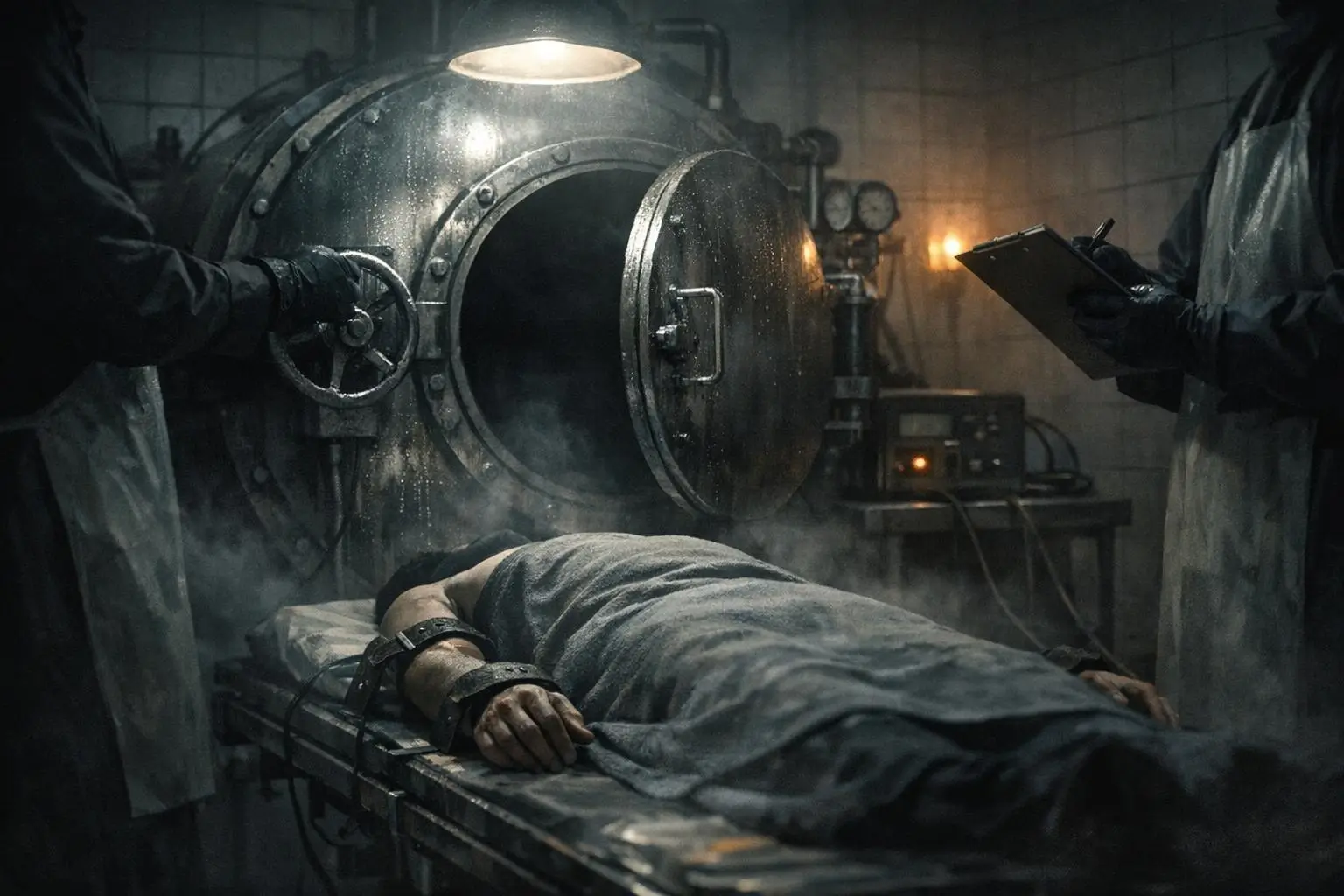
The caption states that a prisoner lost consciousness. It then states that the prisoner died.
No protocol text appears alongside the image. The record does not expand the claim into steps, duration, or a count of subjects.
The caption carries most of the documentary weight in this artifact. The record does not, by itself, map responsibility, authorization, or a chain of documentation.
In this set, the administrative act is the museum’s decision to preserve and publish a captioned photo record that pairs a named camp with a stated fatal outcome.[1]
This artifact can certify only what the museum record states about that image and caption. It leaves open what other documents would show about how the experiment was run.
The baseline perimeter in the USHMM entry on Nazi medical experiments
The USHMM encyclopedia entry provides the baseline claim that German physicians conducted inhumane experiments on prisoners in the Nazi camp system during the Holocaust.
The entry functions as a scope limiter in this set because it establishes actors, victims, setting, and timeframe without requiring added examples.
It does not stabilize, within this set, precise totals, a complete list of experiment types, or a complete map of sites and administrative chains.
The next question is which specific, dated artifacts in the set can serve as fixed points without importing outside protocol detail.[2]
A dated Dachau instance in the GHDI curated document page, marked 1942
The German History in Documents and Images curated page presents a high-altitude simulation experiment on prisoners at Dachau with a 1942 date marker.
This matters narrowly because it pins one named experiment type to one named camp with one explicit year inside the current set.
The curated presentation does not, in this set, supply a complete protocol package, an operational chain of custody, or a stable count of subjects and outcomes.
The next question is how this dated instance relates to the separate photo-caption artifact that also anchors Dachau in the record.[3]
A Harvard-hosted Doctors’ Trial transcript excerpt that preserves testimony about deaths and autopsies
A Harvard Law School Library-hosted transcript sequence from the Doctors’ Trial contains testimony stating that some people died as a result of experiments.
The same excerpt references autopsies as part of courtroom testimony preserved in the transcript record.
This excerpt does not, within this set, function as a full finding of a tribunal. It does not substitute for an official judgment volume.
The next question becomes legal specificity: what the complete published record would certify about charges, findings, and sentences, which are not stabilized here.[4]
The Doctors’ Trial as the postwar legal frame, bounded here by an overview
The USHMM overview describes the postwar Doctors’ Trial, also called the Medical Case, as a proceeding that examined medical crimes and experimentation carried out under Nazi rule.
Within this set, that overview supplies the named accountability frame that allows the topic to be discussed as a postwar legal matter, not only as a set of atrocities.
The record set here does not include the full official Nuremberg Military Tribunals volumes or authenticated judgment texts, so legal outcomes cannot be stated beyond what these summaries and excerpts explicitly contain.
The next question is what the official published judgments would add that is absent from these bounded descriptions.[5]

The Nuremberg Code as an ethics milestone, tied to revelations and trials in the USHMM framing
The USHMM entry presents the Nuremberg Code as emerging in the aftermath of revelations about brutal experiments on prisoners and as linked to the trial context.
In this set, the Code is anchored as a post-revelation artifact, not as a general moral summary added from outside.
The entry does not, within this set, certify how widely the Code was implemented, enforced, or applied in later institutions.
The next question is documentary continuity: what later records, not included here, would show about adoption and practice beyond the moment of articulation.[6]
Auschwitz as a named site for Nazi criminal medical experiments in the camp museum record
The Auschwitz-Birkenau State Museum describes Nazi criminal medical experiments as occurring at Auschwitz and frames them as involving German physicians.
This provides a second named site in the set. It prevents the topic from collapsing into a single-camp narrative built only from Dachau artifacts.
The museum page, as used here, does not stabilize a complete cross-camp comparison, nor does it provide a protocol archive that would allow procedural reconstruction inside this file.
The next question is how many other sites and document types would be needed to move from site anchors to a comprehensive account, which this set cannot support.[7]
Aktion T4 in USHMM: a distinct program category that cannot be collapsed into camp experimentation
The USHMM encyclopedia entry describes the Nazi euthanasia program, Aktion T4, as systematic murder of institutionalized people with disabilities.
In this set, it serves as context for state medical crimes beyond camps, but it remains a distinct documented program rather than a synonym for camp experimentation.
The current record set does not supply a document that formally links Aktion T4 operations to specific camp experiment records, so any direct operational merging would exceed what is stabilized here.
The next question is what authenticated cross-references, if any, would be required to connect these categories without conflation.[8]
Category friction: why this set does not stabilize the label Secret Government Experiments
Many validated sources here document concentration-camp medical crimes, but they do not provide a definitional document that maps these records to the subcategory label Secret Government Experiments.
This creates framing pressure: the file can describe documented camp-based crimes, yet it cannot certify that they fit a modern covert-program taxonomy without a scope definition.
The record has to treat the label as an internal classification problem, not as evidence of an additional hidden layer.
The next question is administrative, not narrative: what project taxonomy document would define that subcategory and its criteria.
What the PubMed index record adds, and what it does not
A PubMed record in this set establishes the existence of a peer-reviewed secondary medical analysis on Dachau hypothermia experiments.
Because only the index record is present here, it cannot import protocol details, specific procedures, or quantified outcomes into this article.
It can only certify that a secondary analysis exists and is indexed in a biomedical database within the boundaries of this set.
The next question is what the full text would document, and whether it cites primary records not included in the current archive slice.[9]
Where this record can still certify, and why it permanently stops short
The surviving record here can certify a baseline: inhumane experiments by German physicians on prisoners in the Nazi camp system during the Holocaust.
It can also certify fixed points: a 1942-marked Dachau high-altitude simulation record, a USHMM photo caption that states loss of consciousness before death, and a trial transcript excerpt that preserves testimony about deaths and autopsies.
Certification stops because the set does not include the full official judgment record for the Doctors’ Trial, and it does not include primary protocol files and correspondence for specific experiments.
It also stops at a classification edge because no scope-defining document is present that would justify treating these camp-based crimes as Secret Government Experiments in a modern covert-program sense.
The opening question remains answered only in part: the archive certifies that these acts were documented, shown, and litigated in fragments, while the full administrative and procedural record is not in view.[2]
FAQs (Decoded)
Does this article claim a complete account of Nazi medical experimentation?
No. It stays inside a limited set of museum entries, a curated document page, a photo caption record, and a trial transcript excerpt, and it marks where those materials stop. Source: United States Holocaust Memorial Museum, encyclopedia entry Nazi Medical Experiments.
What is the single most specific Dachau artifact in this set?
The USHMM photo record captioned as a medical experiment at Dachau, which states a prisoner lost consciousness before dying, is the most tightly bounded single artifact. Source: United States Holocaust Memorial Museum, photo record Medical experiment at Dachau.
What does the 1942 marker actually certify in this file?
It certifies that a curated record presents a Dachau high-altitude simulation experiment on prisoners with a 1942 date marker, without stabilizing full protocols or totals. Source: German History in Documents and Images, curated document High-Altitude Experiment on Prisoners.
What can be said about deaths and autopsies without overstepping the record?
This set preserves transcript testimony stating that some people died as a result of experiments and referencing autopsies, but it does not convert that excerpt into a full tribunal finding. Source: Harvard Law School Library, Nuremberg Trials Project transcript excerpt for NMT 1 Medical Case.
Is Aktion T4 treated as the same thing as camp experiments here?
No. The set treats Aktion T4 as a distinct documented program described as systematic murder of institutionalized people with disabilities, and it avoids collapsing it into camp experimentation. Source: United States Holocaust Memorial Museum, encyclopedia entry Euthanasia Program.
Why is the subcategory label Secret Government Experiments treated as unresolved?
Because the validated sources document camp-based medical crimes, but the set does not include a scope definition that would map those records to that subcategory label without category drift. Source: United States Holocaust Memorial Museum, encyclopedia entry Nazi Medical Experiments.
This file is routed through the forbidden science archive for contested scientific records. Related documentation is indexed under the government experiment records index. For additional case files, see unethical human experiments files and operation paperclip program files.
Sources Consulted
- Photo record Medical experiment at Dachau. encyclopedia.ushmm.org, accessed 2025-02-17
- Encyclopedia entry Nazi Medical Experiments. encyclopedia.ushmm.org, accessed 2025-02-10
- Curated document High-Altitude Experiment on Prisoners (1942). germanhistorydocs.org, accessed 2025-02-03
- Nuremberg Trials Project transcript for NMT 1 Medical Case. nuremberg.law.harvard.edu, accessed 2025-01-27
- Encyclopedia entry The Doctors’ Trial. encyclopedia.ushmm.org, accessed 2025-01-20
- Encyclopedia entry The Nuremberg Code. encyclopedia.ushmm.org, accessed 2025-01-13
- Overview page Medical experiments. auschwitz.org, accessed 2025-01-06
- Encyclopedia entry Euthanasia Program. encyclopedia.ushmm.org, accessed 2024-12-30
- Indexed record related to Dachau hypothermia experiments. pubmed.ncbi.nlm.nih.gov, accessed 2024-12-23

A Living Archive
This project is never complete. History is a fluid signal, often distorted by those who record it. We are constantly updating these files as new information is declassified or discovered.