Manhattan Project Secrecy: What the Records Show—and Where They Stop
What can surviving records still certify about Manhattan Project secrecy, and where do they stop short of procedures and enforcement?
The surviving public-facing record has a few stable documentary objects that can be named and retrieved, even when operational detail does not travel with them.
- Manhattan Engineer District named as an administrative cover choice
- Unclassified and declassified records collection routed to NARA access
- Security characterized as paramount in DOE history materials
- Los Alamos staff arrival and site development described by spring 1943
- Smyth Report presented as an unclassified official summary for public release
These points define the stable edge of certification in the current record set, and they do not extend into a full procedural account.
The USACE vignette that establishes the Manhattan Engineer District as a cover-named administrative unit
A U.S. Army Corps of Engineers historical vignette presents a short administrative pivot in plain language. The page frames the project as something administered through an engineer district.
The vignette states that, instead of another approach, the Corps established the Manhattan Engineer District. The district name appears as the concrete organizational label used for administration.
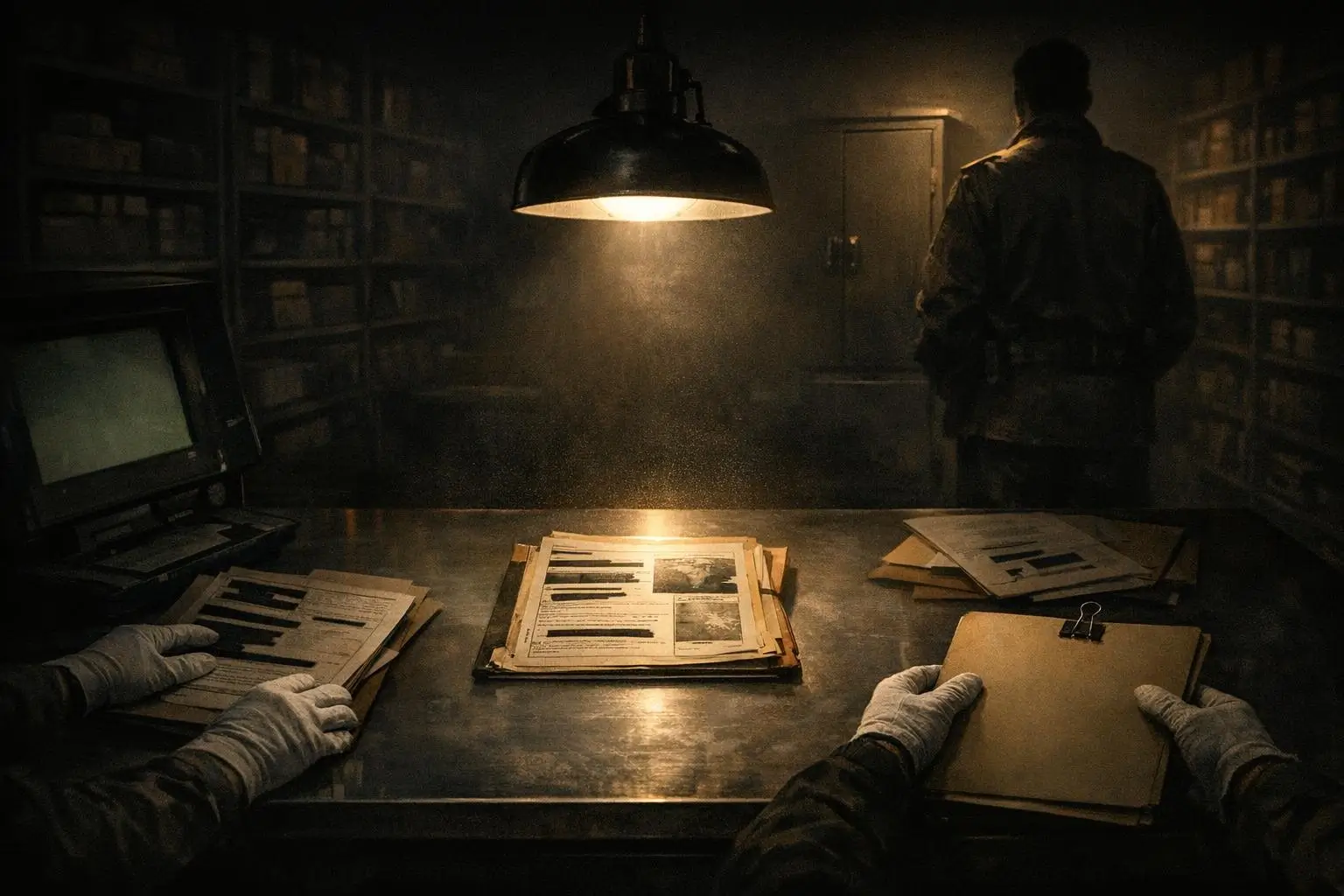
On the same page, the district naming choice is described as intended to hide the development of the atomic bomb. The record, in this form, ties concealment to an institutional name and structure.
The vignette keeps attention on the district as the management container. It does not read like a directive, and it does not present attachments or implementing orders.
There is no catalog of who knew what inside the district on this page. There is also no reproduced set of security circulars that would specify how the cover naming connected to daily procedure.
The documentary object here is the vignette itself and its statement about establishing the Manhattan Engineer District as a cover-oriented administrative unit.[1]
This vignette can certify that a cover-facing name and administrative district existed in the official Corps history framing, but it does not certify the operating rules that made the cover work.
The DOE Legacy Management page that routes Manhattan Project records to NARA
DOE Legacy Management identifies a core unclassified and declassified Manhattan Project records collection accessible at the National Archives and Records Administration. This is a navigation claim first, because it points to where records can be retrieved.
The current record set does not enumerate what a researcher will find inside that collection, and it does not declare it complete. It functions as an access pathway, not a full inventory.
The next unresolved question is which specific series within NARA contain wartime security orders or circulars tied to the Manhattan Engineer District framework.[2]
The DOE OpenNet CIC page that certifies a security posture, not a full rulebook
DOE OpenNet history materials characterize security as paramount in the Manhattan Project. In the same institutional node, military security and counterintelligence roles are presented as associated with the project.
That certification is broad. The provided material does not stabilize the granular mechanics of compartmentalization or need-to-know as enforceable procedures.
The next unresolved question is which primary wartime directives and regulations defined those procedures in writing, since they are not present here as scans or reproduced orders.[3]
The NPS Los Alamos timeline marker that anchors place and staffing, not access control
The National Park Service describes Los Alamos as an isolated mesa location used for laboratory work, and places staffing and site development by spring 1943. This locks a time-and-place marker for a secret site without requiring added operational description.
The current record set does not provide primary documents on how site entry was controlled, how restricted zones were defined, or what pass systems existed at Los Alamos. The same kind of primary access-control evidence is also not validated here for Oak Ridge or Hanford.
The next unresolved question is which declassified site manuals, military police directives, or contemporaneous memos document physical access control across those locations.[4]

The Smyth Report page as a bounded public-disclosure artifact
A historical document page presents the Smyth Report as an unclassified official summary and report of the Manhattan Project for public release after the war. It is a specific disclosure object, framed as a summary rather than an operational file set.
In this record slice, the Smyth Report certifies that an official narrative was prepared for public consumption, but it does not certify what remained outside that summary at the time of release. The page does not, by itself, provide the withheld categories, the internal review steps, or the security directives that shaped what a summary could include.
The next unresolved question is how to connect this public summary to retrievable administrative and security directives in the NARA-routed collections without inventing the linkage.[5]
Espionage context that is bounded to institutional summaries and official declassification portals
DOE OpenNet provides a history page that frames espionage related to the Manhattan Project as an institutional summary node. Separately, the National Security Agency provides a declassification collection for the VENONA project as released historical documents.
These two objects certify that espionage is treated as part of the historical record and that at least one major documentary collection was officially released. They do not, within the current inputs, certify specific operational conclusions, totals, or case-by-case narratives.
The next unresolved question is which specific declassified items, as released, can be tied back to named Manhattan Project administrative and security documents without stepping past what the documents themselves state.[6]
What the current validated record set cannot yet certify about compartmentalization and enforcement
The validated set certifies a cover-facing administrative structure, a strong stated security posture, a timeline marker for Los Alamos, a postwar public summary artifact, and an official declassification pathway. It does not include the wartime security directives and regulations that would define compartmentalization, censorship, and enforcement in operational terms.
It also does not validate direct primary evidence for physical site access control at Los Alamos, Oak Ridge, or Hanford within the captured materials. The brief flags this as a gap requiring retrieval of specific manuals, directives, and contemporaneous memos rather than generalized description.
The next step the record itself implies is procedural: use the DOE Legacy Management route to NARA and seek the Manhattan Engineer District security circulars or orders, then cross-reference with DOE OpenNet document pages where available.[2]
Where Manhattan Project secrecy can be certified here, and where it stops
The opening question asks for a line between what the record can still certify and what it can no longer certify about secrecy. In the current validated set, the line holds at the level of named structures and public-facing artifacts.
The record can certify that the Manhattan Engineer District name is described as a cover-oriented administrative choice, and that security is characterized as paramount in DOE history materials. It can also certify that a core unclassified and declassified records collection is accessible through NARA, and that an unclassified official summary was prepared for public release after the war.
Certification stops where the missing document categories begin: the wartime security directives and regulations are not present here as primary scans, and the physical access-control documentation for major sites is not validated in this set. Without those specific orders and manuals, a procedural account of compartmentalization and enforcement cannot be documentary-locked from these inputs alone.
The unresolved work is therefore archival, not interpretive: locate the specific Manhattan Engineer District security circulars or orders through the NARA access pathway, and then test any procedural claim against those documents.[2]
FAQs (Decoded)
What is the Manhattan Engineer District in the record used here?
It is presented as the U.S. Army Corps of Engineers district structure used to administer the project, with the district name described as intended to hide the atomic bomb development. Source: U.S. Army Corps of Engineers, Historical vignette on the Manhattan Engineer District.
Where does the brief say Manhattan Project records can be accessed?
DOE Legacy Management identifies a core unclassified and declassified Manhattan Project records collection accessible at the National Archives and Records Administration. Source: U.S. Department of Energy Legacy Management, Manhattan Project Historical Resources page.
What does the validated material certify about security overall?
DOE OpenNet history materials characterize security as paramount and associate military security and counterintelligence roles with the project at a high level. Source: DOE OSTI OpenNet, Intelligence and Security organizations page including CIC.
What is the Smyth Report in this record slice?
It is presented as an unclassified official summary and report of the Manhattan Project prepared for public release after the war. Source: nuclearprinceton.princeton.edu, Smyth Report document page.
How is espionage handled without adding outside narrative?
It is bounded to an institutional summary node in DOE OpenNet and to an official declassification collection in the NSA VENONA releases portal. Source: DOE OSTI OpenNet, Espionage history page.
For additional context on classified science archives, explore our documentation on government research records corridor and the area 51 documents file.
Sources Consulted
- U.S. Army Corps of Engineers, Historical Vignette on the Manhattan Engineer District and atomic bomb administration. usace.army.mil, accessed 2025-02-17
- U.S. Department of Energy Legacy Management, Manhattan Project Historical Resources page. energy.gov, accessed 2025-02-10
- DOE OSTI OpenNet, Intelligence and Security organizations page including CIC. osti.gov, accessed 2025-02-03
- National Park Service, Manhattan Project science at Los Alamos article. nps.gov, accessed 2025-01-27
- Atomic Energy for Military Purposes page presenting the Smyth Report. nuclearprinceton.princeton.edu, accessed 2025-01-20
- DOE OSTI OpenNet, Espionage history page and National Security Agency, VENONA Historical Releases portal. osti.gov, accessed 2025-01-13

A Living Archive
This project is never complete. History is a fluid signal, often distorted by those who record it. We are constantly updating these files as new information is declassified or discovered.